An automation can report no errors and still fail to do its job. If the trigger never runs, there may be no failed execution to alert anyone. Meanwhile, the lead stays unassigned or the weekly report never arrives.
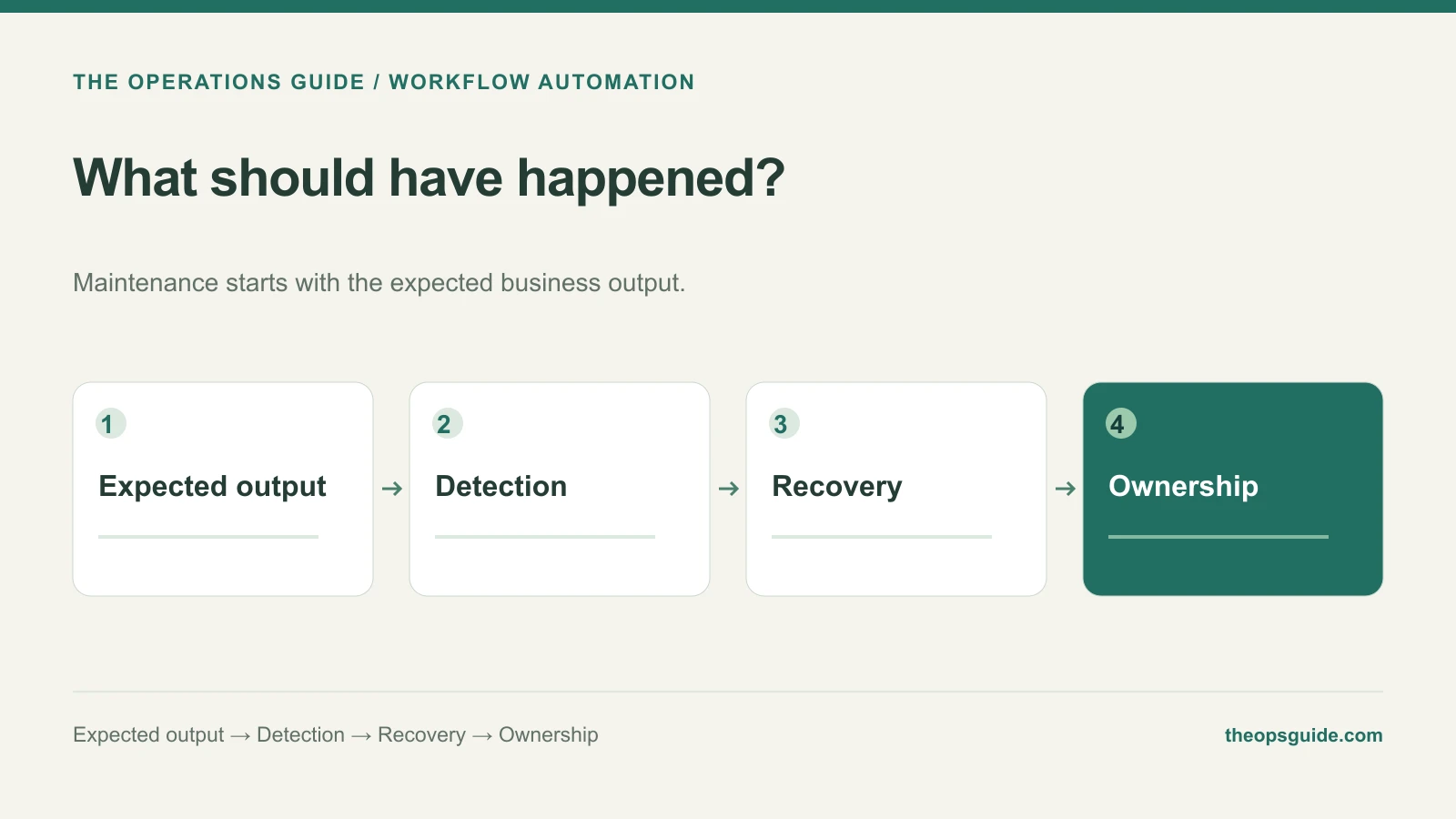
A maintenance plan should begin with the outcome the business expects, then explain how someone will notice when it is missing.
Define what should have happened
For a weekly report, record the expected delivery time, destination, and source period. For new-lead routing, define how a received submission should become an assigned record and how long the business can reasonably wait.
The monitoring method can vary. A small, low-volume workflow may need a scheduled reconciliation rather than an elaborate monitoring service. The important question is whether the check can detect a missing output as well as an explicit error.
For example, n8n error workflows can respond to failed executions. You still need to decide how to detect work that should have started but did not.
Make the coverage concrete
| Area | What the agreement should identify |
|---|---|
| Expected runs and outputs | What should arrive, where, and by when |
| Detection | Which failures and absences are checked, and how often |
| Connections and dependencies | Owner of access renewal, changed fields, and retired services |
| Recovery | Handling for partially completed and duplicate-sensitive work |
| Changes | Boundary between restoring agreed behavior and adding a new process |
| Handoff | Current configuration, business-owned access, and operating notes |
“Monthly support” does not answer these questions. Neither does a promise to keep the workflow healthy without defining what health means.
Ask about partial completion
Suppose a workflow creates a customer record and then fails before adding the delivery project. Starting the entire workflow again could create a second customer. A maintenance provider should understand where the previous attempt stopped and how to complete the remaining action safely.
The recovery method will depend on the systems involved. Ask for a demonstration with an appropriate test record, including how the operator confirms the final state. A green execution icon is less useful than one correct customer and one linked project.
Separate response from repair
Acknowledging an alert is different from restoring service. A provider may be able to investigate promptly while a third-party outage remains outside their control. The agreement should make that distinction clear and identify the temporary manual process, if one is needed.
Choose coverage around the consequence of delay. A report used next Monday and a workflow routing urgent requests may need different attention. Avoid paying for constant monitoring of work nobody acts on until the next weekly meeting.
Keep ownership portable
The business should know who controls the accounts, where the current workflow lives, and how another qualified person would take over. Include recent operating notes and unresolved issues in the handoff, not just a diagram from launch day.
The Ops Guide builds and supports workflow automation. A useful support scope starts with the promised business outcome and the practical steps needed to keep delivering it.