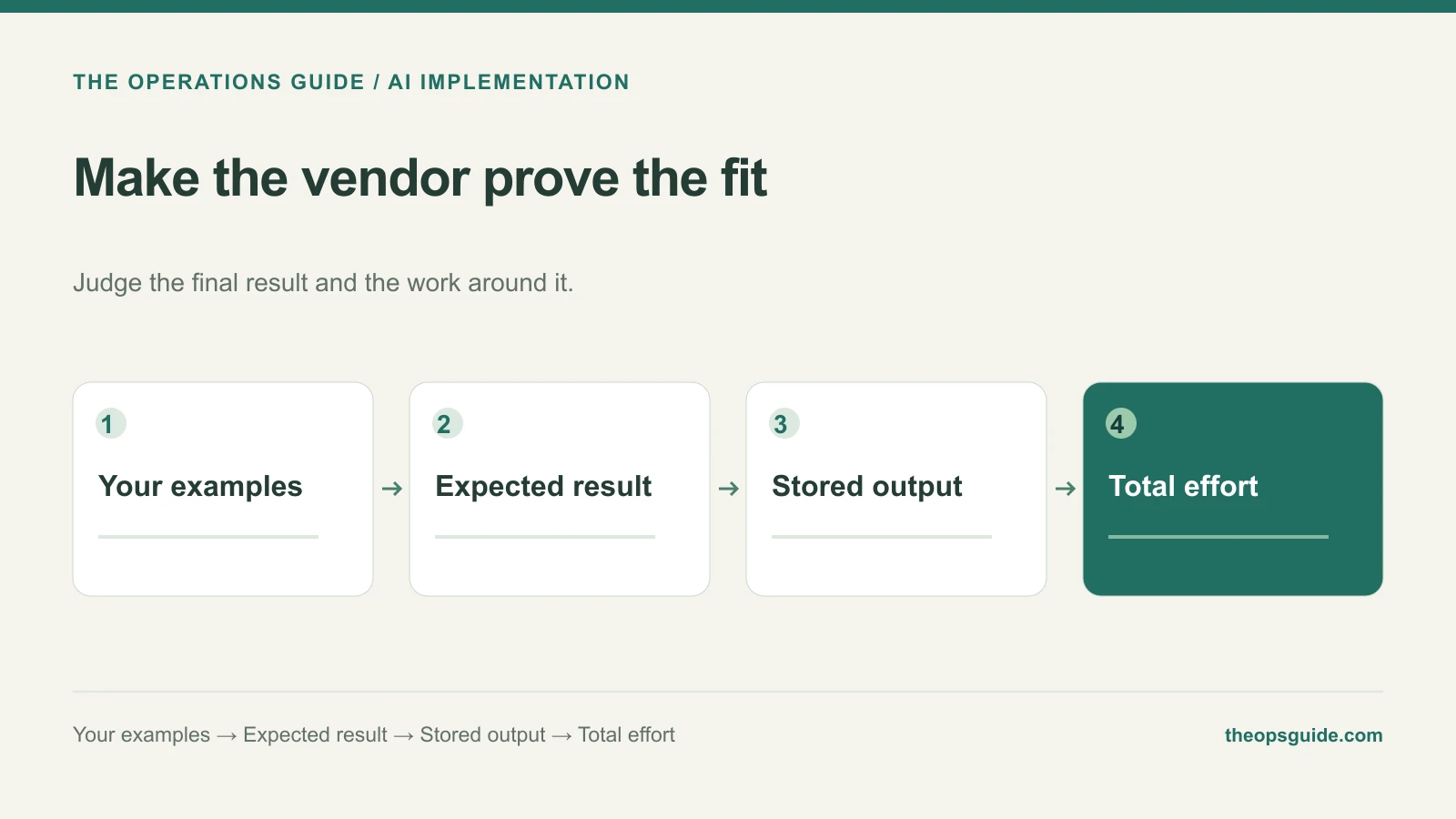
A convincing AI demonstration shows what a product can do with the material chosen for the demonstration. Your buying decision depends on what it does with the work your team will hand it on an ordinary Tuesday.
A useful proof of concept gives the vendor a fair, specific test and gives your team evidence it can inspect afterward.
Choose examples that expose the decision
Suppose you are evaluating a tool that extracts purchase-order details and creates records in a business system. Include ordinary orders, a revised order, a missing delivery date, and an unreadable scan. Use material you are authorized to share and appropriate test environments.
Decide the expected handling before the run. An absent date might require a review flag, not a guessed value. A revised order might need to update an existing record rather than create a second one.
You do not need to invent a universal accuracy target. You do need to identify which mistakes would make the workflow unacceptable and which can be handled through a review step your team can afford.
Use a buyer-controlled demonstration script
| Step | Evidence to inspect |
|---|---|
| Run the agreed examples | Inputs and outputs remain available for review |
| Include missing or ambiguous information | The tool follows the agreed escalation rule |
| Inspect the destination | Stored fields match the accepted result |
| Replay a record-writing example | Duplicate handling follows the agreed rule |
| Correct a result | The team can complete the correction and see its effect |
| Export the result | Useful records remain accessible outside the demonstration |
Duplicate handling matters when the product writes records or takes repeat-sensitive actions. It is not the central test for every conversational tool.
Count the work around the model
Track preparation, review, corrections, and recovery alongside processing time. A fast extraction that takes several minutes to repair may save less work than a slower process with clear exceptions.
Ask the vendor to identify any manual intervention during the trial. Human assistance can be a legitimate part of the service, but the buyer needs to know what was included and whether it will exist in production.
Inspect the final business record. A correct answer on a demo screen does not prove the integration stored the right value in the right customer account.
Set a decision rule before expanding
Write down what would justify proceeding, narrowing the scope, or stopping. Tie that rule to the business consequence of errors and the amount of review the team can sustain.
NIST's AI Risk Management Framework supports evaluation tied to the deployment context. A small pilot helps reveal fit and failure modes; it should not be presented as proof of performance on every future input.
For the purchase-order example, these hypothetical results would lead to different decisions:
- Proceed with a limited rollout: The agreed order types produce correct records, missing dates go to review, and revised orders update the intended record. The team can handle the observed review workload within the time it set aside.
- Narrow the scope: Digital orders work, but scanned orders require so much correction that the reviewer cannot finish the queue. Start with digital orders and keep scans in the existing process.
- Stop and resolve the defect: An unreadable total becomes a plausible number in the purchasing system without a review flag. Require that failure to be corrected before allowing the tool to write purchasing records.
The same product can be suitable for one document type and unsuitable for another. Make the buying decision at that level.
The Ops Guide helps evaluate AI platforms against the work, constraints, and operating responsibilities they will inherit.