Build or buy is where a lot of AI budgets quietly go wrong. Companies build something a tool already does, or they buy a tool for the one thing that was supposed to be their edge. Both are expensive mistakes, and both are avoidable.
Here is how to make the call without overthinking it.
Start from buy
For most needs, buy. The work is common, good tools already exist, and someone else maintains them. Drafting emails, summarizing, scheduling, support replies: these are solved problems. Building your own version is slower, costs more, and gives you something to maintain forever.
Buy is the default. You need a reason to leave it.
When building is the right call
Build when the workflow is genuinely yours, and that difference is where your edge lives. A few real reasons to build:
It is your differentiator. If the process is part of why customers choose you, you may not want it to be the same tool your competitors use.
No tool actually fits. You looked, and the options force you to change how you work in ways that cost more than they save.
Data sensitivity or control. You need the data to stay somewhere specific, or you need control a vendor will not give.
Notice none of these is "it would be cool to build it." That is the trap.
A simple test
Ask three questions:
Does a tool already do 80 percent of this well? If yes, lean buy.
Is this workflow part of our competitive edge? If yes, lean build.
Can we afford to maintain what we build, for years? If no, lean buy.
If you are still unsure after those three, buy. You can always build later once you know exactly what you need.
The hidden costs people miss
Building looks cheaper than it is. The build is the small part. The cost is maintenance: updates, fixes, the person who has to own it, and what happens when they leave. A tool you built that no one maintains is a liability.
Buying has its own costs: lock-in, pricing changes, and the risk the tool does 90 percent of what you need and you contort your process around the missing 10 percent. Go in with eyes open.
The hybrid most companies land on
In practice, the answer is usually both. Buy the platform and the hard parts. Build the thin layer that connects them to how you actually work. You get speed and maintainability from the tool, and the custom fit from a small piece you control. That is where most of the return lives.
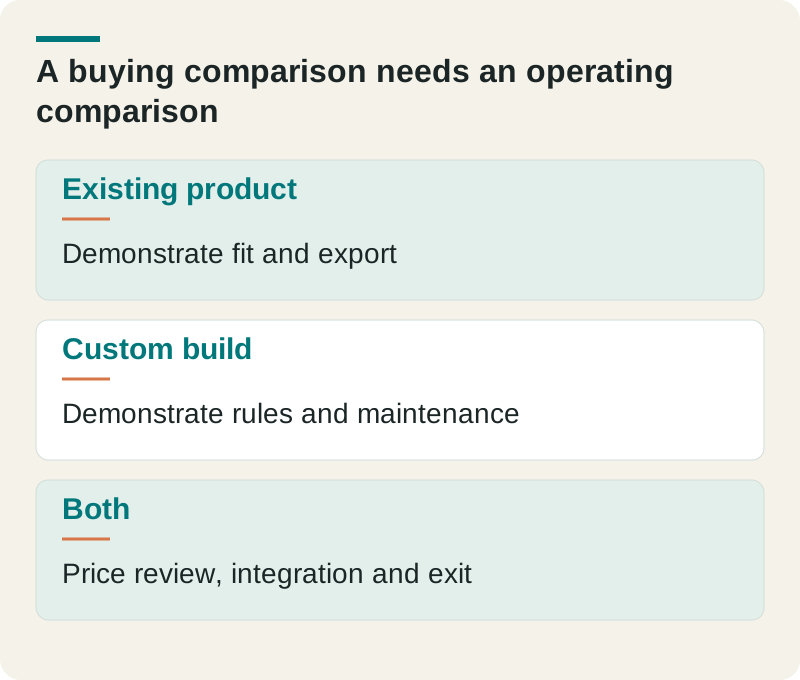
Run the same awkward case in both options
Compare a fictional request with missing information, a later correction, and an approval step. Ask the existing product and the custom-build proposal to handle the same case. A normal demonstration can hide the exception that makes your workflow distinctive.
A buying comparison needs an operating comparison. Original planning aid from The Ops Guide. Any example figures are illustrative unless this article identifies a source.
Existing product
Demonstrate fit and export
Custom build
Demonstrate rules and maintenance
Both
Price review, integration and exit
Keep license fees, implementation, internal support, and exit work in the same observation period. Buying can be quicker when the fit is good; custom work can be justified when a material rule cannot be supported. Neither choice removes the need for a business owner and a working handoff.
The Fractional CAIO service gives your AI work a leader to set priorities and help turn the best ideas into tools your team can use.
Frequently asked questions
Q: Should I build or buy AI?
A: Default to buy. Build only when the workflow is your competitive edge, no tool fits, or you need control a vendor will not give. If a tool already does 80 percent of the job well, buying is almost always the better return.
Q: What are the hidden costs of building AI in-house?
A: Maintenance is the big one: ongoing updates, fixes, and an owner who keeps it running. The initial build is the small part. Factor in years of upkeep, not just the first version.
Q: Is custom AI worth it for a small business?
A: Usually not as a starting point. Buy proven tools first, prove the ROI, and only build custom where you have a clear edge to protect.
Luke Thompson is Co-Founder and CEO of The Ops Guide. He writes about practical uses of AI, workflow automation, custom software, and SEO for growing businesses.