Most "AI strategies" I see are a list of tools. That is not a strategy. That is a shopping list.
A real AI strategy answers one question: where will AI move the business, in what order, and how will we know it worked. Everything else is noise. If your plan cannot say which problem comes first and why, it is not ready.
Here is how to build one that holds up, without a 40-page document nobody reads.
What an AI strategy actually is
It is a short, prioritized plan that ties AI to goals you already have. Grow revenue. Cut cost. Serve customers faster. The AI part is just the means.
A good strategy fits on a page or two. It names the handful of places AI will help, the order you will tackle them, who owns each, and the number you expect to move. That is it.
How to build the roadmap
Anchor to business goals, not technology. Start with what the company is trying to do this year. The roadmap exists to serve those goals, not to "adopt AI."
Map where AI could help. Walk the operation and list the work that is repetitive, high-volume, or slow. This is your candidate list. Keep it grounded in real workflows.
Score by impact and feasibility. Rate each candidate on how much it would move a goal and how hard it is to do. The best first projects are high impact and low difficulty.
Sequence quick wins first. Lead with one or two wins you can ship fast and measure. Early proof buys you the room to take on bigger bets later.
Decide build versus buy, per item. Buy when a tool already does the job. Build when the workflow is specific to how you operate. Decide on return, not novelty.
Set light guardrails. Agree on a few simple rules for data, privacy, and review before things go live. Enough to be safe, not so much that nothing ships.
Assign owners and a number. Every item gets a person and a metric. No owner means no result.
That is the whole roadmap. Short, ordered, owned, measured.
Why most AI strategies stall
The tool-list trap. A pile of subscriptions is not a plan. Start with the problem.
Boiling the ocean. Trying to transform everything at once. Pick the first win and ship it.
No owner. A strategy with no name attached to each move is a wish.
Ignoring data readiness. If the data the tool needs is a mess, fix that first or pick a different starting point.
How this connects to ROI
A roadmap is only as good as the returns it produces. Each item should trace back to a number, the same way we lay out in The CEO's Guide to AI ROI. Strategy picks the targets. ROI proves you hit them.
Give the first project a dependency-aware sequence
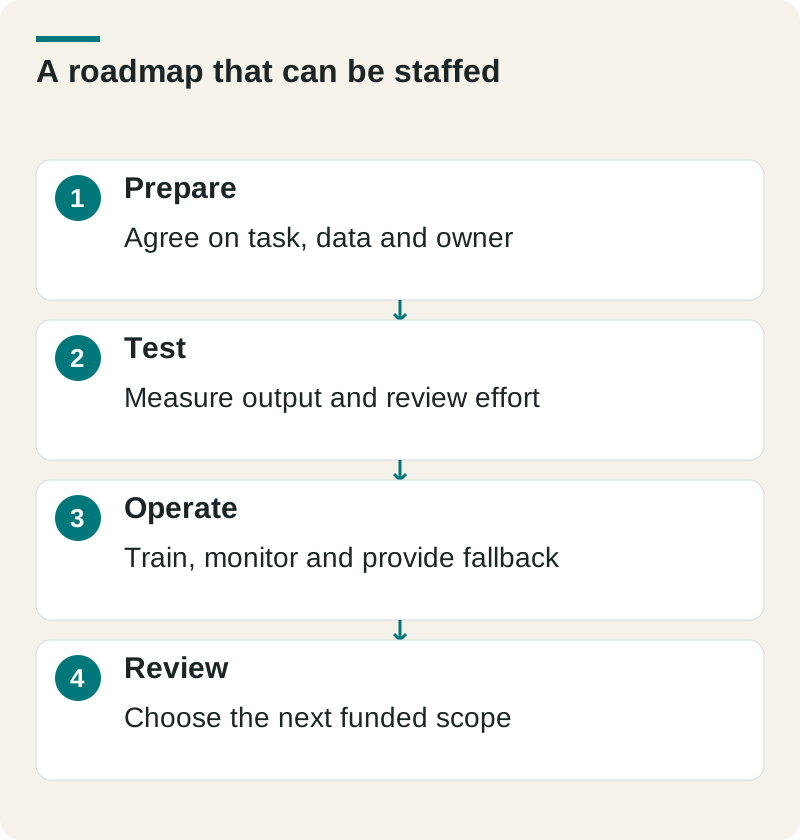
A roadmap with three promising tools is incomplete if all three depend on the same unavailable subject expert. For a hypothetical first release, put source preparation and review capacity ahead of a launch date. Show what must be ready before each stage begins.
A roadmap that can be staffed. Original planning aid from The Ops Guide. Any example figures are illustrative unless this article identifies a source.
Prepare
Agree on task, data and owner
Test
Measure output and review effort
Operate
Train, monitor and provide fallback
Review
Choose the next funded scope
Give the sponsor a decision at each boundary. The team may continue, reduce scope, or stop when the evidence changes. Keep later ideas visible as candidates rather than implied commitments. A workable sequence connects priorities to people and dependencies.
If your AI plan is a tool list, reorder the work around business priorities. Our Fractional CAIO service provides one owner across priorities, rules, team adoption, and implementation.
Book a call and we will build the first version of your roadmap together.
Frequently asked questions
Q: What should an AI strategy include?
A: A short, prioritized list of where AI will help, tied to business goals, with an owner and a target metric for each item, plus simple guardrails for data and review. It should fit on a page or two.
Q: How is an AI strategy different from buying AI tools?
A: Tools are the means, not the plan. A strategy decides which problems to solve and in what order. The tool choice comes after, once you know the problem and the expected return.
Q: Where should a company start with AI?
A: With one high-impact, low-difficulty use case you can ship fast and measure. Early, provable wins build the momentum and trust to take on bigger projects.
Q: Who should own AI strategy in a company?
A: A leader close to operations, with each roadmap item assigned to a specific owner. AI that belongs to "everyone" belongs to no one and rarely ships.
Q: Do I need a big budget for an AI strategy?
A: You can start with a bounded evaluation budget. Set a spending cap, count setup and ongoing review, and measure the result before funding expansion. A first project may not pay for itself.
Luke Thompson is Co-Founder and CEO of The Ops Guide. He writes about practical uses of AI, workflow automation, custom software, and SEO for growing businesses.