Governance sounds like the thing that slows everything down. Done right, it is the opposite. A few clear guardrails let your team move fast with AI because they know where the lines are, instead of freezing or doing something risky.
You do not need an enterprise policy binder. You need a handful of rules that fit your size.
The guardrails that actually matter
Data rules. Be clear on what data can go into which tools, and what cannot. This is the one most likely to bite you if you skip it.
Human review where stakes are high. Anything customer-facing, financial, or legal gets a human check before it goes out. Low-stakes internal work can move faster.
Approved tools. A short list of tools people can use, so you are not scattered across a dozen apps with no oversight.
An owner. One person accountable for the AI guidelines and for answering questions when they come up.
Basic monitoring. A simple way to catch when something drifts or breaks, before a customer does.
That is it. Five things, not fifty.
Keep it proportional
A 20-person company does not need the governance of a bank. The mistake in both directions is real: too little and you risk a costly, public mistake; too much and nothing ships because everyone is waiting for approval. Match the guardrails to your actual risk.
Why this protects ROI
One avoidable mistake, a data leak, a wrong customer-facing answer, a compliance slip, can wipe out the return from a dozen good AI projects. Light governance is cheap insurance. It is also what lets you say yes to more AI, faster, because the risks are handled.
Give one workflow a small permission boundary
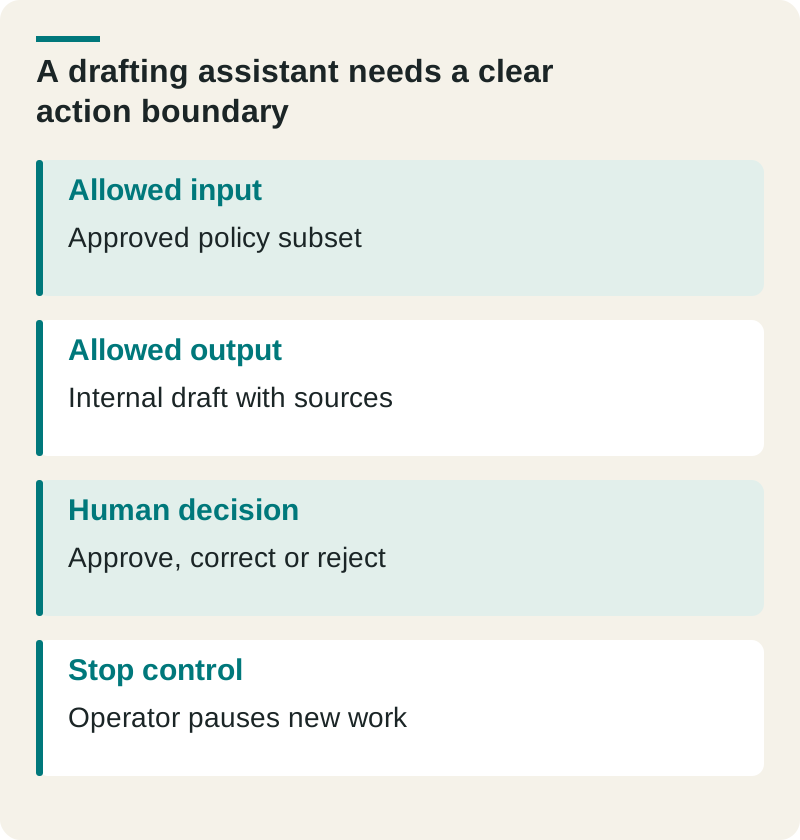
A hypothetical support-drafting assistant can begin with approved policy sources and no authority to send messages. Staff inspect the draft, correct it, and decide whether to send. That is a concrete boundary the team can test without writing a company-wide policy first.
A drafting assistant needs a clear action boundary. Original planning aid from The Ops Guide. Any example figures are illustrative unless this article identifies a source.
Allowed input
Approved policy subset
Allowed output
Internal draft with sources
Human decision
Approve, correct or reject
Stop control
Operator pauses new work
Extend authority only when the business has evaluated the consequences and operating controls for the specific task. Keep a record of changes to sources, permissions, and evaluation. NIST’s AI Risk Management Framework supports responsibilities and evaluation suited to the deployment context; this checklist is our practical implementation example.
Our Fractional CAIO service sets clear limits for data, risk, and review alongside the AI plan and team adoption.
Frequently asked questions
Q: What is AI governance for a business?
A: A small set of rules that keep AI use safe and consistent: what data can go where, human review for high-stakes outputs, an approved tool list, a clear owner, and basic monitoring. For most companies it should fit on a page.
Q: Does a small company need AI governance?
A: Yes, but proportional to its risk. You do not need an enterprise policy. You need a handful of clear guardrails so people can use AI confidently without risking a costly mistake.
Q: How do I set AI guardrails without slowing the team down?
A: Keep them light and clear: data rules, human review only where stakes are high, a short approved-tool list, one owner, and simple monitoring. Clear lines actually speed teams up.
Luke Thompson is Co-Founder and CEO of The Ops Guide. He writes about practical uses of AI, workflow automation, custom software, and SEO for growing businesses.