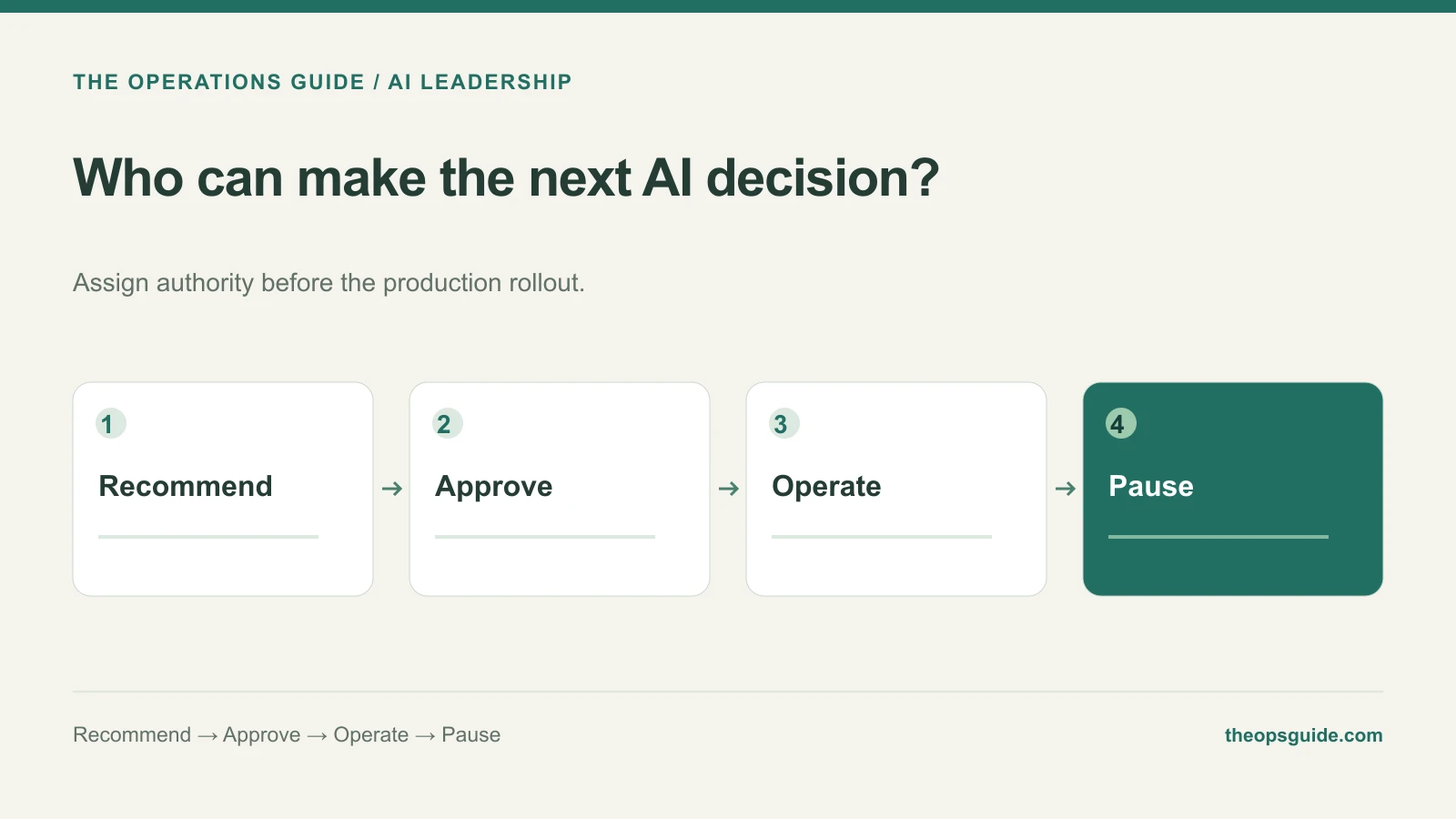
Hiring a fractional Chief AI Officer does not automatically settle who can approve a tool, give it access to company data, or stop it after a bad result. Those decisions need names attached to them before the first production rollout.
The most useful engagement makes expertise available without making the business dependent on one outside person for every routine decision.
Separate the recommendation from the decision
Take a proposed AI workflow that drafts customer responses. The advisor might recommend the tool, design the trial, and explain the tradeoffs. The support leader still needs to define an acceptable response and decide where human review is required. A budget owner approves spending, and the person responsible for the data decides what access is appropriate.
This example matrix gives each kind of work a place. Your titles may differ.
| Decision | Recommends | Decides | Runs the agreed process |
|---|---|---|---|
| Which use case comes first | CAIO with team leads | Business sponsor | Named project owner |
| Which vendor to trial | CAIO and technical owner | Budget owner | Trial lead |
| What data the tool may access | Technical and data owners | Authorized data owner | System administrator |
| Whether to launch | Trial lead with evidence | Named business approver | Workflow owner |
| Whether to pause after a failure | Anyone who detects the issue | Pre-authorized operator within agreed limits | Workflow owner |
One person may occupy several columns in a small company. The point is to make the decision explicit, not to create a committee for each setting.
Make the leadership responsibility concrete
The agreement should also say what the CAIO owns between those decisions: maintaining the agreed priorities, bringing unresolved tradeoffs to the right person, and keeping delivery commitments visible.
In the customer-response example, the support team may have time to review drafts for only one inquiry type. The CAIO should turn that constraint into a smaller launch plan, resolve the change with the sponsor, and coordinate the people needed to deliver it. If implementation falls outside the engagement, name who supplies that capacity before accepting the plan.
At the next review, the sponsor should be able to see what moved forward, what is blocked, and which decision needs their attention. Ask for that responsibility in the scope alongside the advice.
Give the operator enough authority to act
A workflow that sends incorrect drafts to a review queue presents a different problem from one that sends incorrect messages directly to customers. Decide what the operator may disable immediately and what requires escalation.
Put the pause control, the fallback process, and the contact path together. A policy that says “notify leadership” is incomplete if nobody knows whether the workflow should keep running while they wait for a response.
NIST's AI Risk Management Framework emphasizes documented responsibilities and evaluation suited to the context. The matrix above is a practical starting arrangement, not a staffing chart prescribed by NIST.
Require a handoff someone can use
Ask for more than a roadmap at the end of the engagement. The operating team should receive the current configuration, access ownership, evaluation examples, known limitations, and the conditions that should trigger another review.
Include why plausible alternatives were rejected. “We chose this tool” becomes much more useful when the next operator knows it was chosen because it could preserve document permissions, and that a change to those permissions would reopen the decision.
Match the engagement to the missing responsibility
If the business knows what to build but lacks someone to implement it, a development engagement may be sufficient. If competing teams need shared priorities and someone to evaluate the choices, fractional leadership may be useful. Define the decisions you need help making before buying the title.
The Ops Guide's fractional CAIO work connects AI priorities with the people responsible for delivering and operating them.