
A fractional CAIO proposal promises strategy, alignment, and transformation. Those words can describe useful leadership, but they do not tell a buyer what progress they should inspect after paying for three months.
Agree on the decisions and delivered changes the engagement will own. Then identify what your team must contribute for that work to happen. A leader can coordinate an initiative without personally writing all the software, but the proposal should explain where implementation capacity comes from.
Judge a leadership engagement by its commitments
Consider a fictional service company with an AI-assisted quoting pilot. Its sales team likes the draft speed; operations worries about promised delivery dates; finance has not approved how pricing enters the drafts.
The company wants the fractional CAIO to resolve those tradeoffs, define a bounded operating scope, and bring a continuation decision to the executive sponsor. It does not commission a company-wide AI rollout.
| Checkpoint | Acceptance evidence | Client dependency |
|---|---|---|
| Day 30 | Agreed quote scope; approved pricing source; named decisions still blocking release | Finance confirms source and sales supplies representative cases |
| Day 60 | One bounded quoting workflow used by the agreed team, with review and exception handling demonstrated | Implementation team completes agreed changes; operations confirms promise limits |
| Day 90 | Operating evidence, total effort, unresolved limits, and a funded continue/narrow/stop recommendation | Sponsor reviews results and authorizes the next scope |
These dates illustrate a buyer's acceptance discussion. They are not The Ops Guide turnaround commitments or a promise of business returns.
Describe what the CAIO is accountable for
In this engagement, the CAIO brings unresolved choices forward with a recommendation, gets the right people to resolve them, and keeps the approved work moving. The sponsor retains authority over spending and consequential business commitments.
The buyer should be able to see the recommendation, decision, next action, and delivery responsibility. A slide deck listing potential use cases is insufficient evidence for a commitment to make this quoting workflow operational.
Use our CAIO decision-rights guide to clarify authority. Keep those approvals distinct from who must coordinate the work between executive meetings.
Agree on the handoffs the proposal assumes
If your internal developer is unavailable, the day-60 milestone needs a different delivery plan. Ask whether implementation comes from your team, a separate partner, or an included resource, and which work each will complete.
Similarly, the CAIO cannot invent approved pricing or operational capacity. Make the missing inputs visible, with a requested decision and its effect on scope. The leader can still narrow the pilot to an activity that uses confirmed information, such as preparing a draft for review without sending it to customers.
Record the boundary in the acceptance card. “Quoting improved” is vague. “Sales can prepare a reviewed draft using the approved pricing source; unsupported requests remain in a manual queue” gives the sponsor something specific to inspect.
Make the day-90 handover an acceptance test
At the final review, ask the internal owner to run one agreed workflow and handle an exception using the handover. The CAIO can support the exercise, but the client should be able to find the instructions and understand which decisions remain theirs.
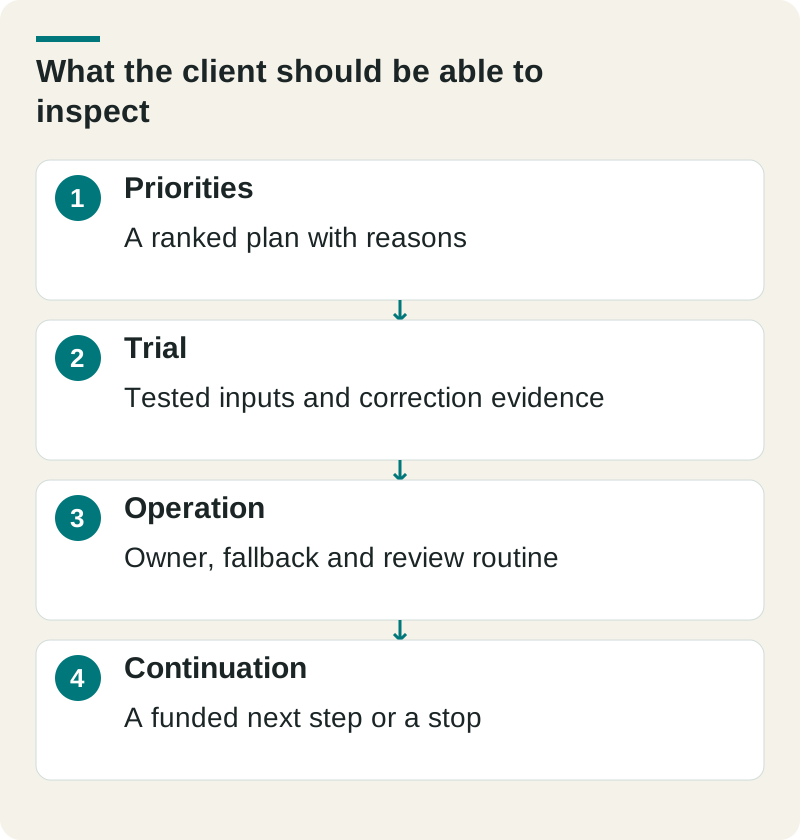
- Priorities
- A ranked plan with reasons
- Trial
- Tested inputs and correction evidence
- Operation
- Owner, fallback and review routine
- Continuation
- A funded next step or a stop
Keep strategy outputs, implemented work, and operating readiness separate in the acceptance record. A roadmap does not prove a workflow is in use. If implementation depended on an unavailable developer, record the resulting gap and revise the next scope rather than relabeling the plan as delivery.
Check this before you proceed
- Inspect the actual delivered records.
- Test one manual fallback.
- Name the owner of the next review.
Download this article’s editable worksheet (CSV). Add your evidence, owner, and review date. For the next related decision, read Who Owns AI Decisions When You Hire a Fractional CAIO?.
Make continuation a choice, not an automatic expansion
At day 90, the sponsor might continue the narrow workflow because it fits the team and preserves quote quality. They might defer expansion because operations cannot support more review. They can stop if the tool's corrections consume the supposed benefit or the necessary data remains unavailable.
The engagement earns that review by presenting operating evidence and a clear recommendation. The broader AI roadmap can then incorporate the funded next phase.
Explore The Ops Guide's fractional CAIO services to discuss which leadership decisions and delivery responsibilities your business needs covered.