Most companies ask, "What AI tool should we use?" It is the wrong first question. The better one is, "Are we ready to get a return from it?"
Readiness is the difference between AI that pays off and AI that becomes another unused subscription. The good news is that being ready has almost nothing to do with how technical you are. It has to do with whether the basics are in place.
Here are the five things that actually decide it.
The five parts of AI readiness
A problem worth solving. You can name where time and money leak today. Readiness starts with a real problem, not a tool looking for a use. If you cannot name the problem, that is the first gap to close.
Data you can actually use. The information the AI needs exists and is reachable, not trapped in someone's head or scattered across ten systems. It does not have to be perfect. It has to be good enough to work with.
Processes that are documented enough. AI improves a process. If the process only lives in one person's routine, there is nothing solid to build on. You do not need a binder, just enough clarity to see the steps.
People who will adopt it. The best tool fails if no one uses it. Readiness includes a team that is open to changing how they work, and a plan to bring them along.
Leadership commitment and an owner. Someone with authority cares about this and someone specific owns shipping it. AI efforts that belong to "everyone" stall. Readiness means a name is attached.
How to score yourself
Rate your company 1 to 5 on each of the five and write the evidence beside each score. The ranges below are rough prompts for discussion, not a validated assessment or a prediction of ROI. Missing permissions or review capacity can block a use case regardless of the total.
20 to 25: Consider a bounded pilot after checking the task, access, and reviewer prerequisites.
12 to 19: Investigate the weakest areas and decide which gaps matter for the proposed task.
Below 12: Resolve the missing operating basics before expanding access or relying on AI outputs.
Notice that most of readiness is operations, not technology. That is the whole point. AI rewards companies that already run well.
What to do if you are not ready
Do not force it. The most common mistake is buying AI to fix a process that was never defined. You end up automating a mess.
Start with the weakest dimension. If your data is scattered, get the key data into one reachable place. If a process lives only in someone's head, write down the steps. Scope the cleanup and measure whether it makes the work easier before assuming a financial return.
Use evidence beside the readiness score
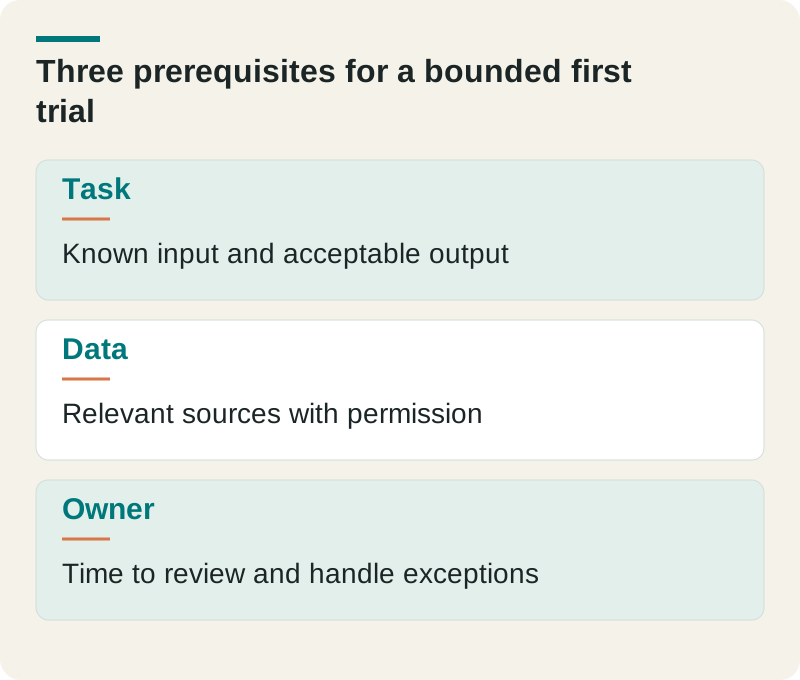
A team can score itself highly and still have no one available to review a result. For a hypothetical support trial, require a current policy source, a list of excluded requests, and a reviewer who can compare drafts with the expected answers.
Three prerequisites for a bounded first trial. Original planning aid from The Ops Guide. Any example figures are illustrative unless this article identifies a source.
Task
Known input and acceptable output
Data
Relevant sources with permission
Owner
Time to review and handle exceptions
Choose one missing prerequisite to resolve before buying more tools. This is an operating check, not a validated maturity assessment. Reassess readiness for each proposed use case because a team ready for internal drafting may not be ready for customer-facing actions.
Book a call and we will score your readiness together and find your best first move.
Frequently asked questions
Q: What does it mean for a company to be AI-ready?
A: It means the basics are in place: a real problem worth solving, usable data, processes documented enough to improve, people willing to adopt, and leadership with an owner. Most of readiness is operations, not technology.
Q: How do I assess my company's AI readiness?
A: Score yourself 1 to 5 on five areas: a clear problem, usable data, documented process, team adoption, and leadership commitment with an owner. Low scores point you to what to fix before you invest in tools.
Q: What if my company is not ready for AI?
A: Start with the weakest area, usually data or undocumented process. Scope the cleanup and test whether it improves the task before assuming a return. Do not buy AI to fix an undefined process.
Q: Do I need clean, perfect data to use AI?
A: No. You need data that is good enough and reachable. Perfect is not the bar. Trapped and scattered is the problem to solve, not imperfect.
Luke Thompson is Co-Founder and CEO of The Ops Guide. He writes about practical uses of AI, workflow automation, custom software, and SEO for growing businesses.