You can buy the best AI tool in the world and get nothing from it. The tool is rarely where AI efforts die. They die because people keep doing the work the old way.
Adoption is the quiet half of AI ROI. Here is how to get it.
Why adoption fails
Fear. People worry the tool is there to replace them, so they quietly resist it.
No training in context. A one-time demo is not training. People need to use it on their real work.
No clear why. If no one explained what problem this solves for them, it feels like extra work.
Forced from the top. A mandate with no buy-in gets surface compliance and zero real use.
How to actually drive adoption
Bring people in early. The team that helped shape it will use it. The team it was done to will not.
Make the new way easier than the old way. If the AI path has more friction than the habit it replaces, the habit wins every time.
Show the win that matters to them. Not "company efficiency." Their Friday afternoon back. Lead with what is in it for the person doing the work.
Pick a champion. One respected person on the team who uses it well and helps others is worth more than any rollout email.
Train on real work. Have people use it on their actual tasks, with support, not a sandbox demo.
Leadership's role
Adoption is set at the top, but not by mandate. It is set by what leaders model and protect. Use the tool yourself. Give people time to learn it instead of expecting instant productivity. And address the fear honestly: be clear about what AI is for and what it is not.
Practice one real exception during training
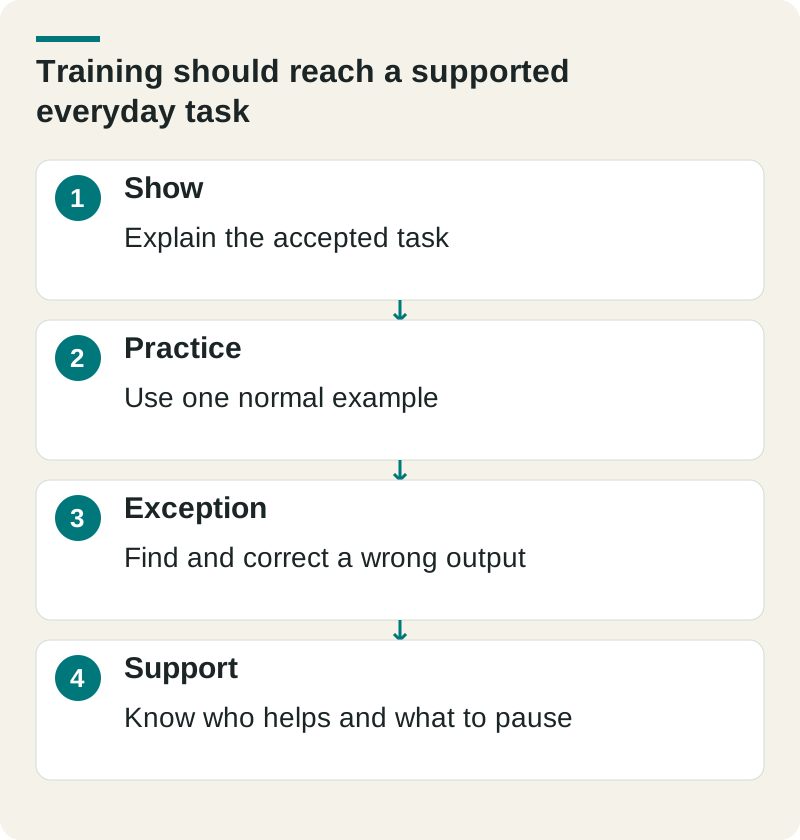
For a hypothetical meeting-summary rollout, training should include a missing decision and an incorrectly assigned action. Ask staff to correct the record using the intended workflow. A demonstration that only shows a polished summary does not teach the recovery step.
Training should reach a supported everyday task. Original planning aid from The Ops Guide. Any example figures are illustrative unless this article identifies a source.
Show
Explain the accepted task
Practice
Use one normal example
Exception
Find and correct a wrong output
Support
Know who helps and what to pause
Reserve time for practice and questions. At the follow-up, inspect whether the tool is used for the agreed task and why people avoid it when they do. Adoption problems can reflect poor fit, unreliable output, or unavailable support; they do not all call for another training video.
People and adoption are one of the five parts of readiness in Is Your Company AI-Ready?. It is the one most often treated as an afterthought, and most often the reason good tools go unused.
Our Fractional CAIO service helps people use AI in their day-to-day work, with one owner connecting priorities, rules, adoption, and implementation.
Frequently asked questions
Q: Why won't my team use the AI tools we bought?
A: Usually because of fear, no training on their real work, no clear reason it helps them, or a top-down mandate with no buy-in. The fix is involving people early and making the new way genuinely easier than the old one.
Q: How do I drive AI adoption on my team?
A: Bring people in early, make the AI path lower-friction than the current habit, show each person the win that matters to them, pick a respected champion, and train on real tasks with support.
Q: Whose job is AI adoption?
A: Leadership sets it, by modeling the tools, giving people time to learn, and being honest about what AI is for. But day-to-day momentum usually comes from a champion on the team.
Luke Thompson is Co-Founder and CEO of The Ops Guide. He writes about practical uses of AI, workflow automation, custom software, and SEO for growing businesses.