A pilot that works is not a result. The result is a process that runs in the business, every day, without the person who built the pilot babysitting it. The distance between those two is the pilot-to-production gap, and it is where most AI value quietly dies.
The pilot proved it could work. Crossing the gap is about making it actually work, for real, at scale.
Why pilots stall at the gap
No owner. The pilot belonged to whoever built it, and no one owns the production version.
It lived on a laptop. The workflow was never integrated into the systems the team actually uses.
No adoption plan. The tool works, but people keep doing it the old way.
No monitoring. When it breaks or drifts, no one notices until something goes wrong.
None of these are technology problems. They are the unglamorous operational work that turns a demo into a dependable process.
What crossing the gap takes
Assign a production owner. A specific person accountable for it running, not just building it.
Integrate it into real workflows. It should live where the work already happens, not in a separate tool people have to remember to open.
Document it. Write down how it works and what to do when it does not, so it survives the person who built it.
Plan adoption. Bring the team in, make the new way easier than the old way, and confirm it actually stuck.
Monitor it. Set a simple check so you catch drift or breakage before a customer does.
A short production-readiness check
Before you call a pilot done, ask:
Does someone own this in production?
Is it integrated where the work happens?
Is it documented well enough to hand off?
Have people actually adopted it?
Will we know if it breaks?
If any answer is no, you are still in the gap.
Make the operating owner demonstrate a failure
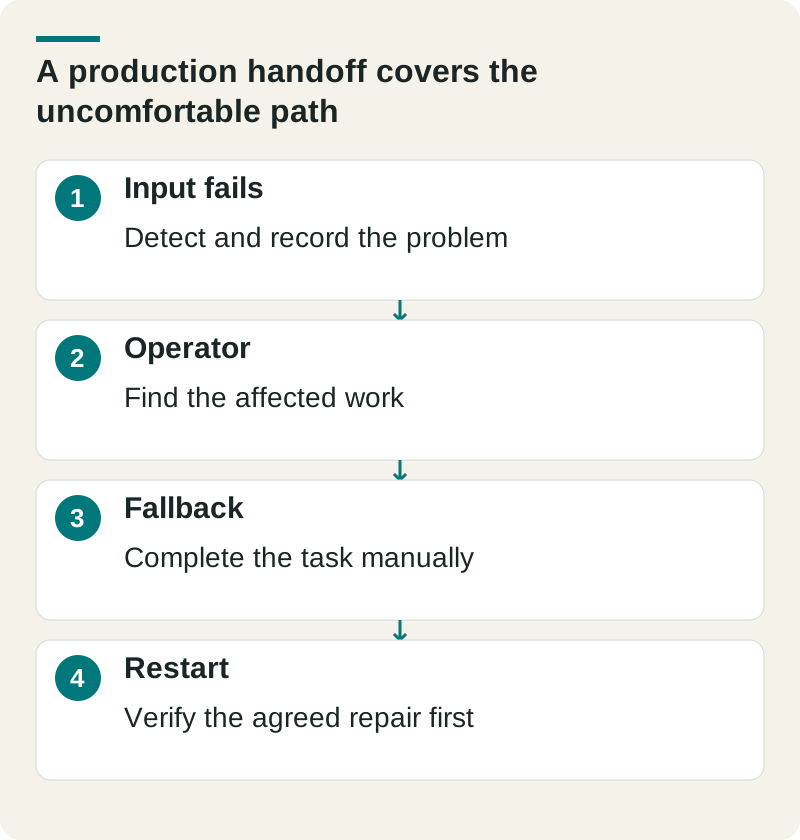
Before launching a hypothetical document assistant, disable its source connection in the test environment. Ask the operating owner to find the affected requests, use the manual fallback, and explain how completed work will be reconciled when the connection returns.
A production handoff covers the uncomfortable path. Original planning aid from The Ops Guide. Any example figures are illustrative unless this article identifies a source.
Input fails
Detect and record the problem
Operator
Find the affected work
Fallback
Complete the task manually
Restart
Verify the agreed repair first
A successful exercise tests the handoff and reveals missing instructions. Keep the release scope bounded and record the restart conditions. Production readiness concerns the people, dependencies, and recovery path as well as the normal output quality.
Our Fractional CAIO service provides one owner across the plan, rules, team adoption, and the work of turning ideas into systems.
Frequently asked questions
Q: What is the AI pilot-to-production gap?
A: It is the distance between a pilot that works in a test and a process that runs reliably in the business. Most AI value dies here, and the causes are operational: no owner, no integration, no adoption, no monitoring.
Q: Why do AI pilots fail to scale?
A: Usually because they were never built to scale: they lived on one person's setup, were not integrated into real workflows, had no owner for the production version, and no one planned for adoption.
Q: How do I move an AI pilot into production?
A: Assign a production owner, integrate it into the systems people already use, document it, plan and confirm adoption, and set up monitoring. If you cannot answer yes to all five, it is not production-ready yet.
Luke Thompson is Co-Founder and CEO of The Ops Guide. He writes about practical uses of AI, workflow automation, custom software, and SEO for growing businesses.