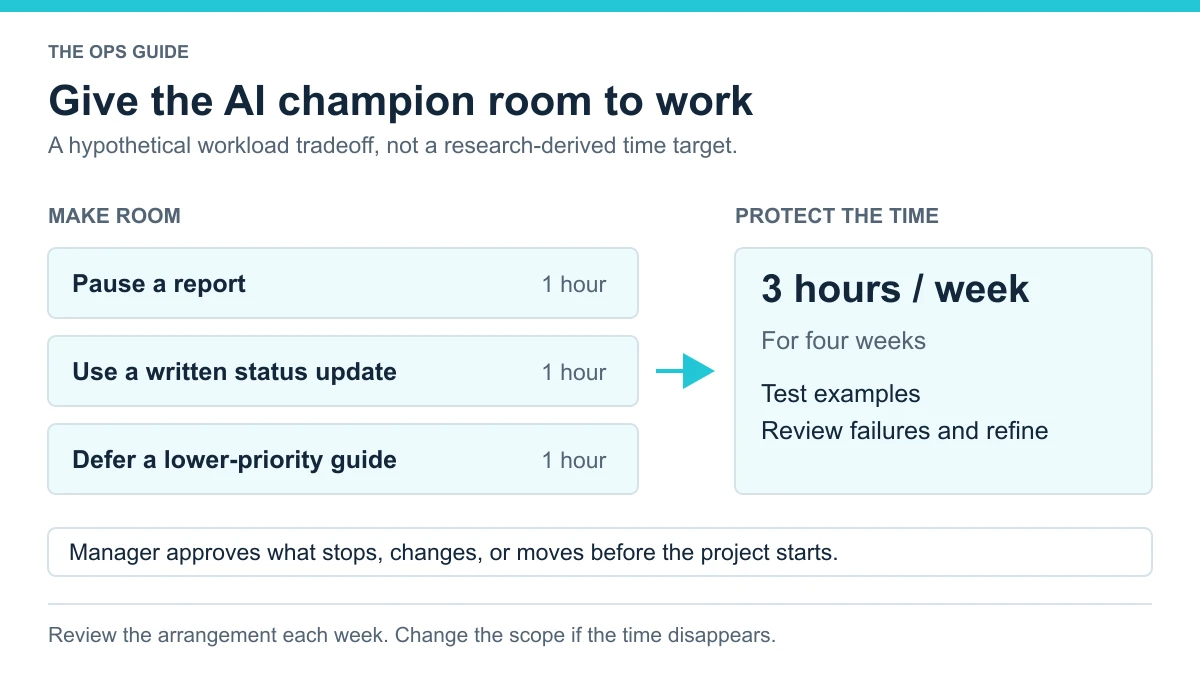
Give your AI champion time to test and support the project by removing specific work from their existing schedule.
It’s an easy detail to skip. Someone on your team knows the process, likes experimenting, and has already built something promising. You ask them to help the rest of the company use it. Their regular responsibilities stay exactly where they were.
Now they’re testing examples, answering questions, explaining mistakes, and fitting in another meeting. The useful little project has become a second job.
If you want that work to continue, make room for it.
The work behind the working demo
In a September 9, 2026 research explanation, MIT Sloan described a two-year field study at an academic medical center and a corporate law firm. Researchers found that developing shared AI solutions added work: experimenting, reviewing results with colleagues, and adapting the solutions over time. Support and recognition for that effort differed between the organizations, alongside employees’ continued participation.
That’s evidence from two organizations, so it doesn’t establish what happens in every small business. It does give leaders a practical reason to examine the workload they’ve assigned.
A demo might involve one person getting a good answer. A shared process requires someone to check whether that answer holds up across different situations. Someone also has to explain the process, collect problems, and decide what needs fixing.
Write those responsibilities down before asking your champion to roll the tool out. Otherwise, they’re easy to leave out of the schedule.
Make a specific workload tradeoff
Start with a short conversation involving the champion and their direct manager. List the next four weeks of AI work, estimate the time required, and identify which existing commitments can change.
Here’s a hypothetical example. An operations manager is testing an AI assistant that drafts internal project handoff notes. The company agrees to protect three hours a week for four weeks.
| Existing commitment | Agreed change | Weekly time made available |
|---|---|---|
| Preparing a report nobody currently uses to make a decision | Pause it for four weeks | 1 hour |
| Attending two recurring status meetings | Send an update and attend only when a decision requires their input | 1 hour |
| Updating a lower-priority internal guide | Move its deadline back four weeks | 1 hour |
| Total | Manager approves the changes | 3 hours |
Those three hours now cover testing handoff notes, reviewing failures with a colleague, and updating the instructions. The exact allocation will vary. The manager must agree to the tradeoff.
Handing the displaced work to someone else creates another capacity problem unless that person also has room. Pausing, simplifying, or delaying work can be more useful than moving it around.
Protect the agreement when the week gets busy
Put the AI work on the calendar and give it a defined outcome. For this example, the four-week outcome could be a tested handoff process, a short list of situations that still need manual handling, and a recommendation about whether to continue.
Keep a brief weekly check-in with the manager. Review what was completed, what interrupted the scheduled time, and whether the next week’s workload needs adjusting.
If customer work repeatedly takes priority, acknowledge that choice and move the project date. Expecting the same deadline after removing the time creates pressure to finish the work after hours or skip the checks.
Recognition matters here, too. Include the assignment in the person’s goals and performance conversations. Checking a flawed output and stopping it from reaching the next team is useful work, even when it produces nothing impressive to show in a meeting.
For the broader work of helping colleagues use a new process, see our guide to team adoption of AI. This workload agreement gives the person leading that effort time to follow through.
Where a fractional CAIO can help
A fractional Chief AI Officer can help turn a broad request into a manageable assignment. That includes defining the work, estimating the support it requires, and negotiating protected time with the line manager.
They can also help settle conflicts when one department expects faster progress while another controls the champion’s schedule. The direct manager still needs to approve the workload changes. An outside adviser’s plan only becomes workable when the people assigning daily work agree to it.
Start small. Choose one project, protect a realistic amount of time, and review the arrangement after four weeks. If the business can’t free that time, reduce the scope or defer the project.
Before your next AI project meeting, write down the work you’re asking your champion to do and the commitments you’ll remove to make it possible. Get their manager’s agreement, then put both changes on the calendar.