
Your account managers finish their meeting notes sooner. They say AI has given them time back, but the overdue renewal list has not changed.
Before buying another tool, decide where that capacity should go. Freed time can disappear into a fuller inbox, extra meetings, or cleanup of the AI output. You need a specific reassignment that fits the people and the work.
The NBER paper Shifting Work Patterns with Generative AI reports individual time savings in its workplace experiment without detecting a corresponding change in the quantity or composition of tasks. That finding concerns a particular integrated tool and setting. It gives leaders a useful question to investigate: after a task gets shorter, does anyone change the work plan?
Start with capacity your team can use
In this hypothetical example, four account managers each verify two hours a week of net capacity after note review and corrections. The manager does not record that as a payroll reduction. The employees remain employed, and the company has no evidence of cash savings.
Ask when the time becomes available. Ten minutes between calls may support record cleanup; it may not support a complicated renewal conversation. Group compatible work into a protected block, and keep a buffer for demand swings.
A four-week allocation you can copy
The team has 24 overdue renewal reviews. Each manager agrees to use one of the two available weekly hours on this backlog. The other hour remains unassigned until the team confirms that the initial gain holds.
| Week | Assigned work | Check at Friday review |
|---|---|---|
| 1 | Four managers each inspect two renewal records | Eight records have accurate dates and a named next action |
| 2 | Contact customers whose review confirms a due renewal | Record responses and unanswered contacts separately |
| 3 | Review the next eight records and follow up agreed actions | Check whether note corrections displaced the protected hour |
| 4 | Finish remaining record reviews and assess the approach | Compare backlog age, follow-through, and service quality |
These are proposed activities, not predicted renewal wins. Customer response and sales outcomes remain uncertain. The plan gives the manager enough detail to see whether the team used the capacity on the intended work.
Subtract the new work before assigning the gain
If managers save two hours of drafting but spend an hour correcting names, commitments, and dates, allocate the net hour. Include the time another employee spends handling exceptions. Moving cleanup from an account manager to an assistant does not remove it from the business.
Keep the old quality standard. A shorter note process that loses a customer's commitment can create more work than it removes. At the weekly review, inspect a small selection of completed records and the customer's next promised action. Adjust the allocation if the team needs extra review time.
Also permit people to reduce overwork. If the original hours came from evenings, using the improvement to end the workday on time can be a deliberate management choice. Record it as that outcome instead of inventing additional capacity for the daytime backlog.
Reconcile the time gain with work completed
In a hypothetical week, a manager releases three hours from note preparation but spends one hour checking outputs and maintaining the process. Two hours remain available. Assign one of those hours to the renewal backlog and leave the other uncommitted while the gain is still being tested.
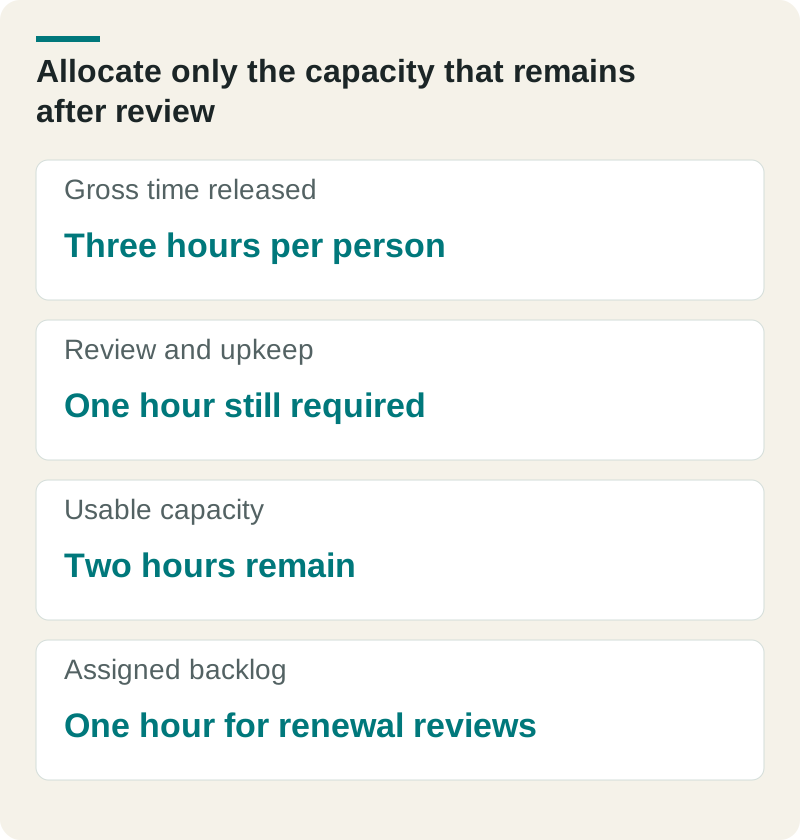
- Gross time released
- Three hours per person
- Review and upkeep
- One hour still required
- Usable capacity
- Two hours remain
- Assigned backlog
- One hour for renewal reviews
At the four-week review, inspect the renewal records completed and whether quality held. Capacity is useful only when the team can put it to work. Do not convert the available hours into a cash-saving claim if payroll and other spending remain unchanged.
Check this before you proceed
- Subtract review and upkeep once.
- Assign a specific backlog and owner.
- Inspect completed work after the trial.
Download this article’s editable worksheet (CSV). Add your evidence, owner, and review date. For the next related decision, read How to Measure AI ROI: A Simple Method for CEOs.
Decide what to keep after four weeks
Keep the arrangement if employees can sustain it and the chosen backlog improves without lowering service quality. Change the assigned work if the protected blocks do not fit the task. Stop expanding the allocation if corrections consume the apparent gain.
Use our AI ROI guide for the distinction between capacity value and realized cash savings. For leadership help connecting AI improvements to operating priorities, explore The Ops Guide's fractional CAIO services.