AI spending is hard to evaluate without a baseline. A tool gets bought and the work feels faster, but the analysis needs to include the full cost and what the business actually gains.
Measuring AI ROI is not hard. It just has to happen on purpose, before you start. Here is the method.
The formula
ROI = (value gained minus cost) divided by cost.
For financial ROI, express benefits and costs in dollars over the same period, then multiply the result by 100 for a percentage. Track freed hours separately as capacity. A loaded hourly rate can value that capacity for planning, but it does not turn unchanged payroll into cash savings. Count added revenue at its contribution after the costs of serving it.
The five steps
Set a baseline first. Before you build anything, write down what the work costs today. Hours per task, times how often, times a loaded hourly cost. No baseline, no ROI.
Pick one primary outcome. Freed hours, spending reduced, or contribution from added revenue, tied to one workflow. Also check quality, rework, and service levels so faster output does not hide a worse result.
Count the full cost. Include software, setup, training, review, rework, and ongoing maintenance. Separate additional cash spending from the value of existing staff time.
Measure the after. Run the workflow with AI for a few weeks and capture the new number. Compare it to your baseline.
Project cautiously. Use expected working weeks, task volume, and adoption to estimate a full year. Compare benefits and costs over that same period, and label the result a forecast until measured.
A hypothetical worked example
Assume a support team handles 200 replies a week for 48 working weeks a year. Drafting and checking each reply takes 10 minutes. At a loaded staff cost of $40 an hour, that is about 33.3 hours a week, or $64,000 of staff time a year.
Suppose a trial finds that AI-assisted drafting takes 3 minutes per reply and human review takes another 2 minutes. Add 1 hour a week to maintain the workflow. Total recurring staff time is about 17.7 hours a week. The difference is 752 hours over 48 weeks, with a capacity value of $30,080 at the same hourly rate.
Assume the tool costs $200 a month for all 12 months, and setup and training take 20 staff hours at $40 an hour. That adds $2,400 in software fees and $800 of staff time in year one. Review and maintenance were already included above; do not count them twice.
The 752 hours represent capacity made available before setup and training. They are not $30,080 of cash saved if payroll stays unchanged. Record what the team actually does with that capacity. A documented reduction in overtime or contractor spending can become a financial benefit; avoiding a future hire remains a forecast until the hiring need and its avoidance are established.
Keep the capacity case separate from cash ROI. For example, if this hypothetical company verifies $12,000 of contractor spending eliminated during the year and incurs only the $2,400 in additional cash costs above, cash ROI is ($12,000 minus $2,400) divided by $2,400, or 400%. That cash view excludes unchanged payroll; the internal time commitment still belongs in the investment decision. Do not add the value of the same freed hours to the contractor savings.
These are illustrative assumptions, not a client result. Expand only after checking the actual costs, quality, workload, and use of the time made available. The example gives you a way to test the case before committing more money.
What to avoid
Vanity metrics. "We sent 10,000 AI messages" is activity, not return. Tie it to hours or dollars.
Forgetting adoption cost. If people do not use it, the savings are theoretical. Count the time to get adoption, and check that it stuck.
Measuring too late. If you did not set a baseline, you are guessing. Start the measurement before the project, not after.
Check the arithmetic without mixing cash and capacity
Using the assumptions above, 200 replies at five minutes each require 16.7 hours per week. Add one maintenance hour, then compare with 33.3 manual hours. The annual difference across 48 working weeks is 752 hours before the 20 setup and training hours.
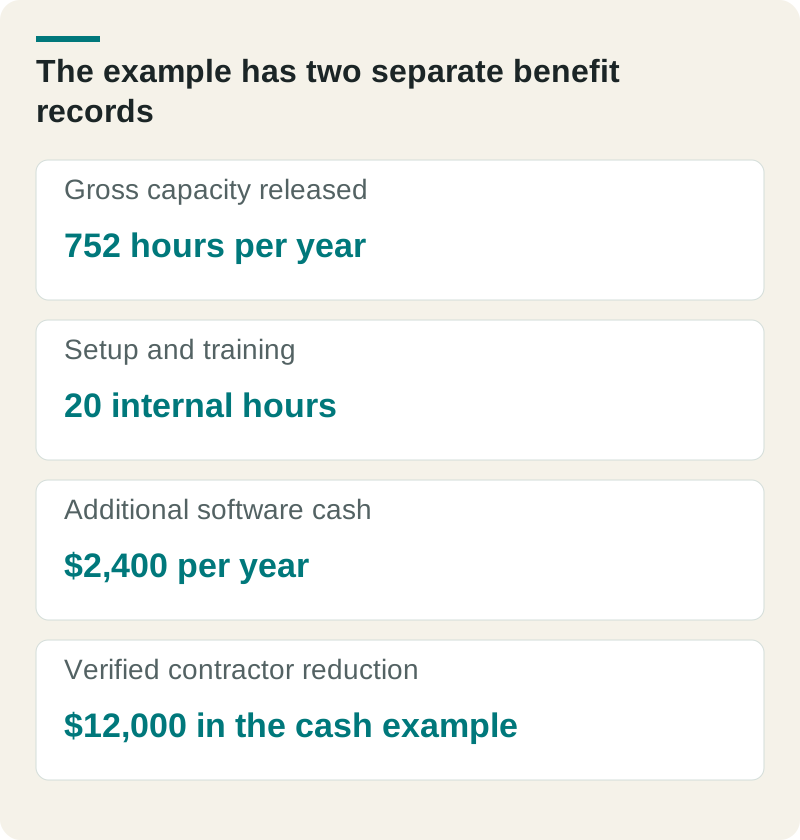
The example has two separate benefit records. Original planning aid from The Ops Guide. Any example figures are illustrative unless this article identifies a source.
Gross capacity released
752 hours per year
Setup and training
20 internal hours
Additional software cash
$2,400 per year
Verified contractor reduction
$12,000 in the cash example
Keep that capacity calculation separate from the illustrative contractor-spending calculation. Count a financial benefit only when the business verifies the spending or contribution change. Do not add the value of the same released hours to the contractor reduction.
Check this before you proceed
Match weekly workload to annual working weeks.
Count setup and recurring effort once each.
Label forecasts separately from measured benefits.
Measuring is step four of the bigger loop in The CEO's Guide to AI ROI: find the work, do the math, pilot, measure, scale. Our Fractional CAIO service leads the AI plan and measures results against the business.
Book a call and we will measure your first use case together.
Frequently asked questions
Q: What is a good ROI for an AI project?
A: Use your normal investment hurdle, with benefits and costs measured over the same period. Check quality, adoption, and ongoing support costs before expanding. Keep available staff capacity separate from realized cash savings.
Q: What costs should I include in AI ROI?
A: Include software or usage fees, setup, training, review, rework, and maintenance. Separate additional cash spending from existing staff time, and use the same period as the benefits.
Q: How soon can I measure AI ROI?
A: As soon as you have a baseline and a few weeks of "after" data. For a focused use case, that can be within a month.
Luke Thompson is Co-Founder and CEO of The Ops Guide. He writes about practical uses of AI, workflow automation, custom software, and SEO for growing businesses.