Your business pays for a custom application. Six months later, a new developer asks for the source code, deployment account, and database backup. Your team has an application login and a folder of screenshots.
Agree on the assets you need before commissioning the build. Payment, access to the running product, and the ability to maintain it are separate questions. Your agreement should describe what your company receives and how another qualified person can take over.
Write an ownership schedule beside the scope
The following schedule illustrates a fictional job-management application. Use it as a conversation with the builder and whoever reviews your contract. It does not determine your legal rights.
| Asset | Proposed controller | Handover condition |
|---|---|---|
| Application source and change history | Company-controlled repository | Company administrator can invite a replacement developer |
| Hosting and deployment | Company billing account | Runbook explains a deployment and rollback |
| Customer records and attachments | Company-controlled storage | Export retains record relationships and file references |
| Email and payment integrations | Company accounts | Administrator can replace the builder's access |
| Third-party components | Listed in the agreement | Licenses, fees, and transfer restrictions documented |
A platform-based build may not provide the same portable source or hosting choice as a conventional application. Ask the builder to explain the actual platform constraints. You can accept them when the benefits fit the business, but your continuity plan must reflect those constraints.
Operating costs belong in that comparison too. Ask which recurring services your proposed build depends on, what they cost today, how pricing changes with use, and who will maintain them.
Ask about the boundary between your work and theirs
A builder may use a reusable framework, licensed component, or earlier tool. Ask which parts they will transfer, which parts they license, and which parts require an ongoing subscription. Have the agreement describe your permitted use and future modification rights in terms your reviewer can evaluate.
Separate those questions from ownership of your customer data. If your builder retains rights to a reusable library, your business still needs a defined way to retrieve its records and attachments. Avoid treating a “full export” as complete until someone explains the format and relationships it preserves.
For example, a spreadsheet of job rows is insufficient if the approval history lives in another table and the attachments have temporary links. Ask for a sample export containing one closed job, one amended job, and one job awaiting approval. A replacement team should be able to understand each record without asking the original builder to interpret it.
Demonstrate the handover while the builder is present
Arrange a short handover exercise using the company administrator account. Confirm that your team can access the repository or platform editor, identify the deployed version, and locate backup instructions. Then have someone other than the original builder follow the deployment or recovery instructions in a safe environment.
This exercise tests the usefulness of the materials. It does not require an owner to become a developer. You need evidence that a qualified replacement has a workable starting point and that your administrator controls the necessary invitations and billing.
Record exceptions. Perhaps a vendor approves account transfers, or an export cannot retain a particular audit field. Assign an interim arrangement and a date to resolve it before final acceptance. Put unresolved dependencies beside the completion checklist, where they can affect the decision to sign off.
Ask a second developer to use the handoff
Before final acceptance, ask another developer or the company’s designated technical owner to inspect the handoff. They should be able to find the source, deployment instructions, required services, and data export process without relying on the original builder’s personal account.
Consider an illustrative AI-enabled application. The company receives its code repository, but part of the process still lives in a vendor’s workflow editor. During handover, ask the replacement maintainer to trace one sample request through both systems, locate the configuration, and identify the accounts needed to operate it. Record what would have to be rebuilt if that vendor were removed. This gives the business a more useful continuity plan than a repository link alone. This exercise applies the continuity question in my discussion of vendor dependence.
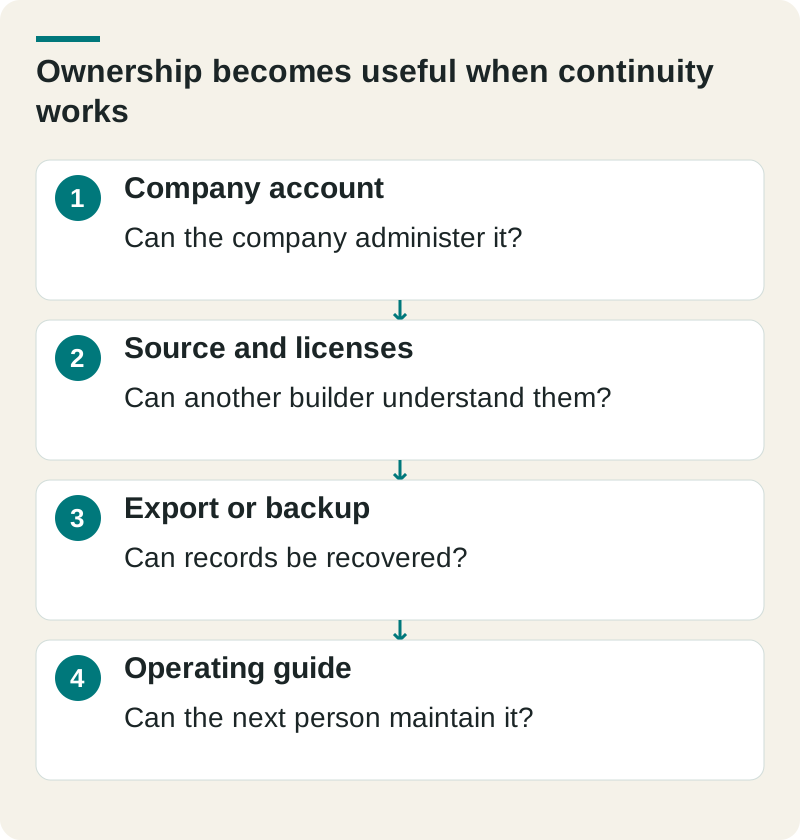
- Company account
- Can the company administer it?
- Source and licenses
- Can another builder understand them?
- Export or backup
- Can records be recovered?
- Operating guide
- Can the next person maintain it?
Separate an ownership claim from a usable recovery path. Confirm the agreed backup or export actually contains the records and relationships the business needs. Have the relevant legal terms reviewed where necessary; a successful technical handoff does not decide intellectual-property rights.
Check this before you proceed
- Verify company-controlled account access.
- Open a representative export.
- Record dependencies and renewal owners.
Download this article’s editable worksheet (CSV). Add your evidence, owner, and review date. For the next related decision, read Internal Tool Requirements: Define the Records, Actions, and Exceptions.
Buy the continuity you need
A small internal tool may justify a lightweight handover. An application handling customer commitments needs more. Choose the assets and recovery expectations according to the work at risk rather than asking for a folder labeled “everything.”
Our internal-tool requirements guide covers the records and actions the application must support. For help agreeing on a build and a usable handover, explore custom software development with The Ops Guide.