
Your marketing coordinator can revise a service page. They cannot change the booking software, approve access to the website, or recover a failed deployment. Giving them the SEO project without those dependencies does not create an internal SEO team.
Choose DIY or outside help task by task. Some work belongs with people who know your customers. Other work needs specialist judgment, implementation access, or a level of continuity your team cannot provide.
Map capacity against actual work
Use a real month of availability rather than a job title. In this fictional service business, the coordinator has four hours a week, the owner can review copy on Fridays, and an outside developer manages the site.
| Work | Internal capacity | Useful delivery choice |
|---|---|---|
| Confirm supported services and customer questions | Owner and field team know the facts | Keep inside the business |
| Revise one service page | Coordinator can draft; owner can approve | DIY with a clear brief |
| Diagnose an inaccessible page template | No available technical reviewer | Buy a bounded specialist investigation |
| Deploy and verify template repairs | Existing developer controls the system | Developer implements an agreed repair |
| Review performance and adjust priorities | Coordinator has limited measurement experience | Use periodic support until capability improves |
This mix avoids buying ongoing work you can complete while leaving a technical problem unresolved. It also prevents an agency engagement from becoming a second coordination job nobody budgeted time to do.
Check the work after the draft
Writing an article or changing a title is only part of the assignment. Someone needs to confirm the facts, publish the change, inspect the page on mobile, and respond if the inquiry path breaks.
For each task, name the person who can complete it and the person who can undo a damaging change. If you cannot identify either, narrow the task or obtain help before giving someone production access.
Google notes in its SEO hiring guidance that small local businesses may be able to handle much of the work themselves. The practical test is whether your people can finish and maintain the specific work your website needs.
Look at the calendar you are displacing
Four hours of SEO work can fit a quiet week and fail when the coordinator covers reception. Ask what task loses time when you add the responsibility. In the example, preparing customer appointment reminders is a higher immediate priority during the busy season.
Plan a smaller commitment: one service-page revision a month, with a defined approval appointment. Buy the technical investigation as a separate project and keep its implementation request with the existing developer. That arrangement may fit better than either full DIY or a broad outsourced retainer.
Keep internal hours distinct from cash expenses. A salaried employee's existing time has a capacity cost, but it does not disappear from payroll when you hire a provider. Compare the work displaced and any actual new spending rather than claiming instant savings.
Price the handoff your own team cannot complete
A marketer who can write useful service copy may still be unable to repair a booking integration. List that dependency before comparing an agency fee with a do-it-yourself plan. Both options need an authorized person who can implement and verify the repair.
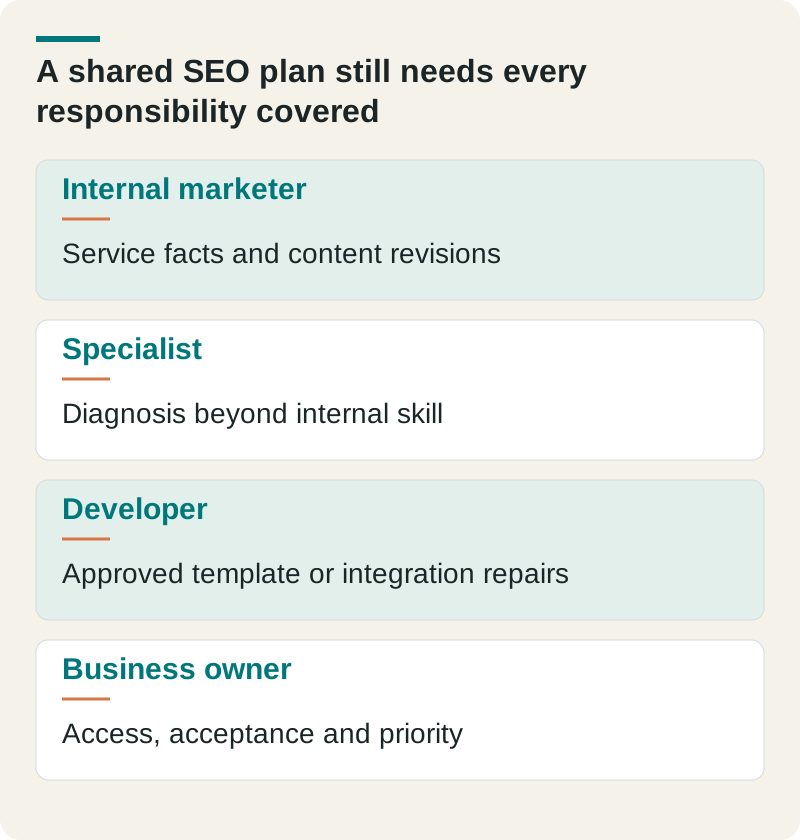
- Internal marketer
- Service facts and content revisions
- Specialist
- Diagnosis beyond internal skill
- Developer
- Approved template or integration repairs
- Business owner
- Access, acceptance and priority
Choose outside help for a defined gap and keep the internal work that your team can support. Confirm available hours and approval dates. Hiring an agency does not remove the need for accurate service information or a reachable client decision maker.
Check this before you proceed
- Assign implementation as well as writing.
- Confirm access before kickoff.
- Test one completed change before expanding scope.
Download this article’s editable worksheet (CSV). Add your evidence, owner, and review date. For the next related decision, read Five Questions That Reveal How an SEO Company Works.
Choose the next scope, then revisit
DIY makes sense when someone can deliver the work, access the necessary systems, and check the result. Outside help makes sense when a real skill or availability gap blocks that delivery. Shared delivery can work if the handoffs have explicit dates and responsibilities.
Review that choice after the first completed change. If approvals stall, more agency output will not solve the bottleneck. If technical diagnosis consumes the coordinator's month, bring in the missing expertise.
Our SEO provider interview guide helps you assess outside judgment. For a conversation about the portion your team needs handled, explore managed SEO from The Ops Guide.