Your sales team wants an AI research tool. Support wants faster replies. Operations has an automation that works when its creator is available to fix it. Someone needs to decide what deserves attention and who will carry the work forward.
That situation calls for different help than a single team asking whether one product can extract information from invoices.
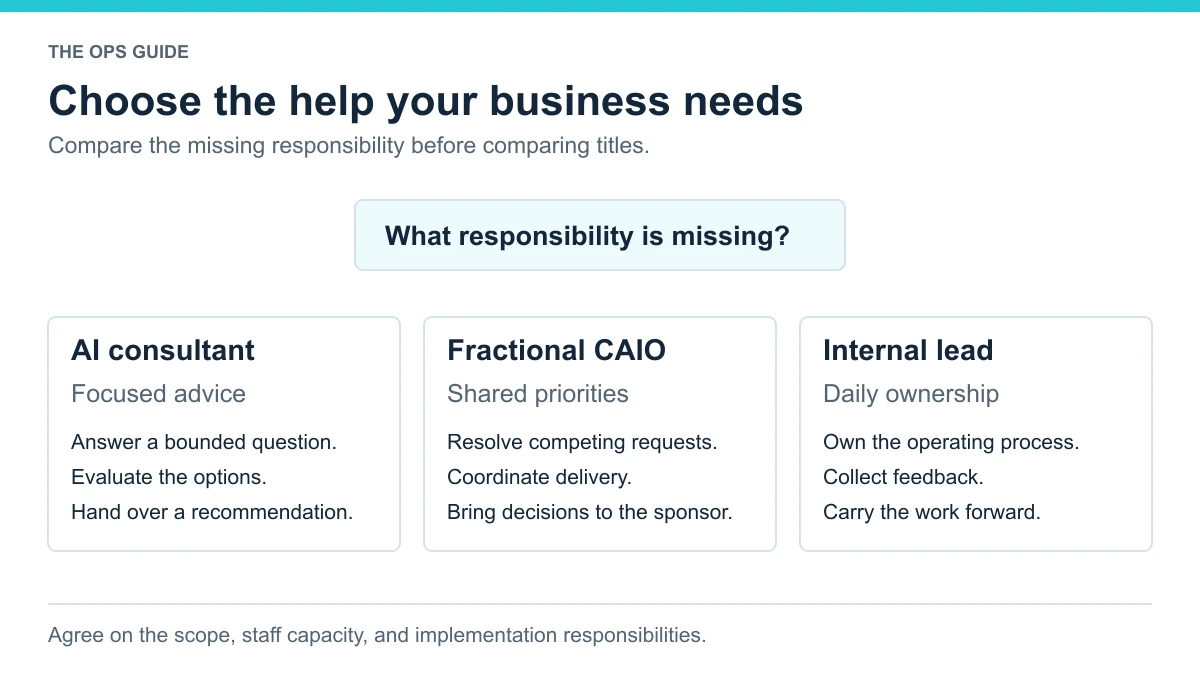
Before comparing titles, identify the responsibility you need filled. A bounded question may need a consultant. Recurring decisions across teams may need a fractional Chief AI Officer. An existing employee may be the right lead when they have the knowledge, authority, and time to own the work.
Match the help to the missing work
These are useful ways to compare scopes, not rigid definitions of professional titles. A consultant can lead delivery, and a fractional CAIO engagement can include implementation. The agreement needs to say which responsibilities are included.
| What your business needs | A useful starting option | What to ask that person to own | What your business still needs to provide |
|---|---|---|---|
| Answer a defined question, such as which document tool fits a particular workflow | AI consultant | The evaluation, recommendation, and an agreed handoff | A decision maker and someone to act on the recommendation |
| Resolve competing AI requests, coordinate teams, and keep an agreed plan moving | Fractional CAIO | Priorities, tradeoffs, delivery coordination, and recurring executive decisions | An executive sponsor, staff participation, and agreed implementation capacity |
| Improve a process the team understands and manage its daily use | Internal lead | The workflow, user feedback, operating decisions, and follow-through | Protected time, authority, and specialist help where their skills stop |
Read across the row before choosing the person. An outside advisor cannot create staff capacity by putting a deadline in a plan. An internal lead cannot resolve a cross-company priority dispute if leadership has never given them that authority.
When a focused consultant is enough
Consider a hypothetical distributor comparing two tools for reading supplier documents. The operations manager knows which fields matter, IT can support the connection, and the business has someone available to run the resulting process. The unresolved question is whether either product handles the documents well enough.
A focused evaluation could answer that question and leave the manager with a recommendation, the examples behind it, and a clear next step. Ask whether configuration and rollout are included or require separate work.
The useful finish is a decision the business can act on. If the same engagement also needs to settle competing department budgets, rebuild the operating process, and coordinate an ongoing delivery team, that broader responsibility should appear in the scope.
When fractional leadership earns its place
Now consider a hypothetical services firm where sales, delivery, and finance each want a different AI project. All three depend on the same small IT team. The owner keeps approving promising ideas, but no one resolves which project takes priority when the work collides.
A fractional CAIO could help turn those requests into an agreed set of priorities, coordinate the people doing the work, and bring unresolved spending or scope decisions back to the sponsor. The leadership value is in keeping those choices connected as circumstances change.
Ask what happens between meetings. Who follows up when a dependency slips? Who brings a recommendation when the first use case proves less valuable than expected? Who coordinates the change with the affected team?
Our guide to who owns AI decisions in a fractional CAIO engagement covers the approval boundaries. This choice comes first: does your business need someone to carry that recurring leadership responsibility?
When an internal lead is the better starting point
An internal lead can be someone already in the business. Assign the responsibility to someone with the time and authority to carry it. You may already have that person on staff.
For example, a hypothetical support manager already owns the response process, understands its exceptions, and has time to improve it. They may be well placed to lead an AI drafting rollout, with focused technical help for setup and integration.
Before assigning the role, ask what comes off that person’s existing workload. Also identify the decisions they can make without waiting for the owner. “You’re our AI person now” gives someone responsibility without the conditions needed to succeed.
An internal lead and outside help can work together. The internal person supplies operating knowledge and continuity; the outside engagement can supply a specific skill or leadership capacity that is missing.
Make the choice concrete before the next sales call
Write a short brief covering the work that is stuck, the decision that needs to be made, who can implement it, and who will operate the result. Ask each provider to respond to that same brief.
If the decision is already made and the missing resource is a builder, describe the build you need. If priorities keep changing across teams, describe the leadership gap. If a capable internal owner can carry the work with focused help, make that role explicit.
Talk with The Ops Guide about fractional CAIO support. Bring the competing requests or stalled project; we can help define the leadership and delivery responsibilities the engagement needs to cover.