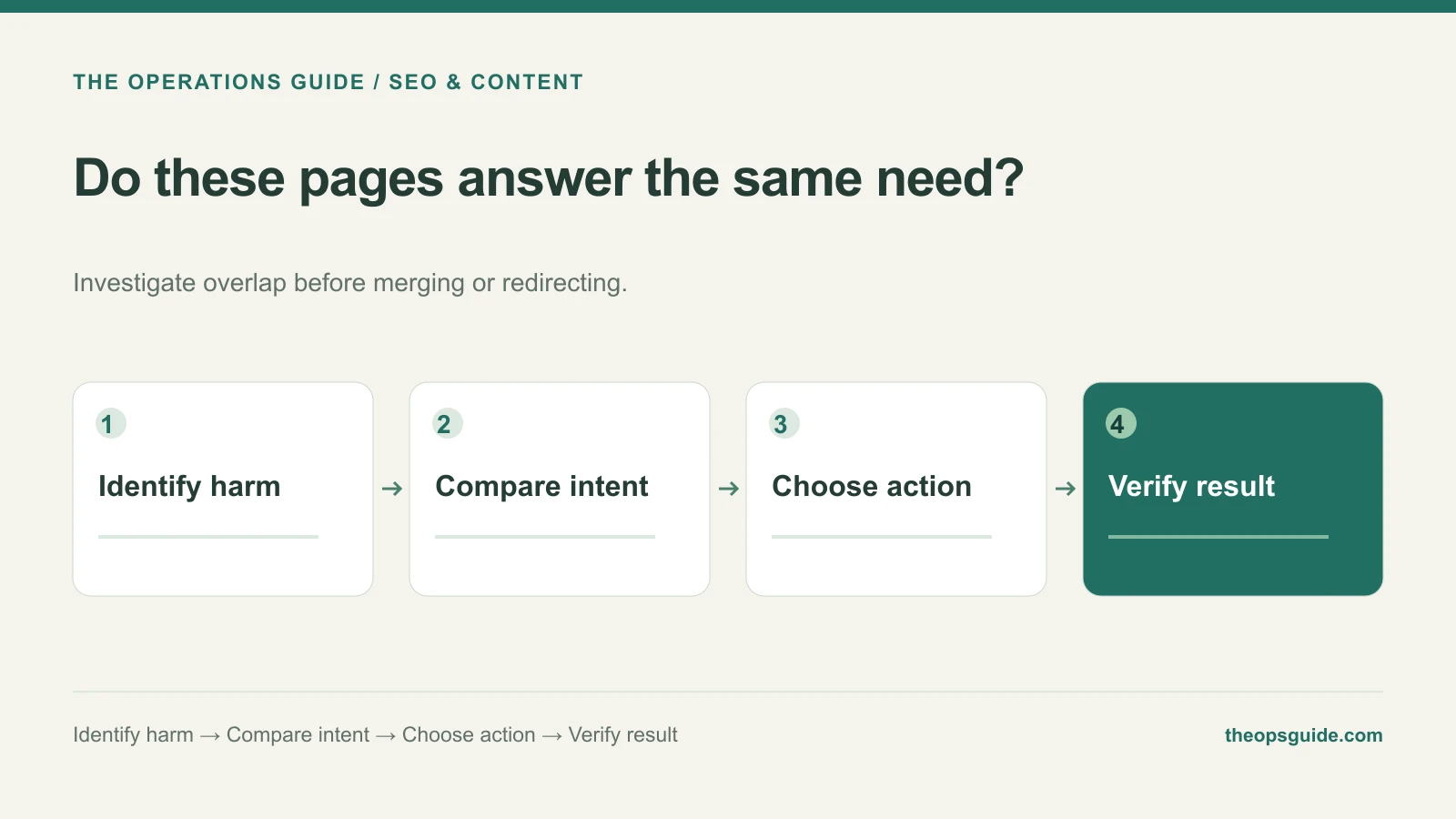
An SEO tool flags two pages for the same keyword. It is tempting to merge them and move on. But a service page and a practical guide can share vocabulary while helping the reader do different things.
Before changing either page, name the problem you’re trying to solve.
Look for harm beyond the overlap
Is a weak or outdated page reaching customers instead of the useful one? Do both pages give substantially the same answer? Does the team keep splitting updates between two versions of the same guide?
Those observations deserve investigation. Two URLs appearing for a query, by itself, does not establish that either page damages the other.
Search Console lets you filter a query and inspect the associated pages. Compare a consistent period and the relevant audience context. Avoid making a structural decision from one day’s ordering.
Compare the job each page does
Read the pages side by side without looking at the keyword list. Write one sentence explaining what a visitor should accomplish on each.
For an illustrative bookkeeping business, these jobs could be distinct:
- A monthly-service page helps a buyer evaluate ongoing bookkeeping support.
- A preparation guide helps a new client gather the records needed for onboarding.
Both can mention bookkeeping and records. Their scope, examples, and next steps should make their separate purposes clear.
Choose the smallest useful correction
| What you find | A reasonable response |
|---|---|
| Different customer tasks, clear pages | Keep both and connect them where useful |
| Different offers hidden behind similar copy | Clarify titles, scope, examples, and next steps |
| Same task, redundant or conflicting explanations | Consider one stronger page |
| URL variants showing essentially the same content | Review canonical and redirect signals |
The table is a decision aid, not an automatic deletion rule. Check links, useful content, and business relevance before retiring a page.
Use consolidation deliberately
If one page can answer the same need more completely, choose the destination and preserve the useful material before redirecting the retired address. The replacement should satisfy someone following an old link.
Canonical annotations serve a different purpose: they signal a preferred representative among duplicate or very similar versions. Google explains the available methods in its duplicate-URL consolidation guidance. A canonical is not a way to make an unrelated article disappear, and it does not force Google’s selection.
Record the change so you can judge it
Note the affected pages, the reason for the change, and what you expect to become clearer for visitors. Review subsequent page and query behavior alongside useful inquiries. Keep other major changes visible so you don’t credit every movement to the merge.
For future assignments, use keyword mapping before creating another page. If the existing site already has overlapping content and unclear ownership, The Ops Guide can help review the options.