
Quick answer
Start with local SEO when customers need someone who can serve a particular place. Put more weight on broader organic SEO when customers choose you for expertise you can deliver across locations. Many service businesses need both. Choose the first investment by the customer you want, the service you can deliver, and the search results those customers see.
Start with how the customer buys
A plumbing company and a remote bookkeeping firm may both call themselves service businesses. Their customers can still use search in different ways.
A homeowner with a leaking pipe needs someone available nearby. A founder comparing bookkeeping firms may care more about industry experience, reporting, and the onboarding process. Those differences should shape an SEO brief before anyone proposes a monthly article count.
In this guide, “traditional SEO” means the work that helps website pages appear in organic search results. Local SEO adds a geographic focus, including eligible Google Business Profiles and visibility in local results. These approaches overlap: a local business still needs useful website pages, and a national firm can publish information relevant to a particular market.
Check Business Profile eligibility before planning around Maps
Google generally allows a Business Profile for a business with a location customers can visit or one that travels to customers. Its rules also cover service areas, addresses, and the use of virtual offices. Review Google’s business representation guidelines against your actual operation.
A mailing address does not, by itself, establish eligibility. A business that works only online should not assume it can create profiles in every city where it wants customers. Confirm eligibility before including profile creation in a proposal.
This is a useful purchasing check: ask the provider to explain which parts of your business qualify and which proposed work depends on that eligibility. Record the answer alongside the scope.
Use this decision matrix
The following matrix is an original planning framework. It is not a Google ranking formula.
| Business situation | First emphasis | Website work that still matters | Evidence to collect |
|---|---|---|---|
| Customers visit one staffed location | Local visibility | Services, location details, clear booking path | Search results near the location and qualified inquiries |
| Your team travels within a defined service area | Local visibility, subject to eligibility | Honest service coverage and relevant service pages | Where accepted jobs originate and travel constraints |
| You deliver a specialist service remotely | Broader organic search | Specific service pages, useful explanations, credible evidence | Customer questions, search queries, and sales conversations |
| You serve both local and remote customers | Separate workstreams | Distinct pages only where the offer or customer need differs | Lead quality and outcomes by service and geography |
Use the matrix to choose an initial emphasis. Do not treat it as a fixed budget split. A broken inquiry form or a service page that fails to explain the offer can limit either approach.
A local offer needs more than a profile
Google says local results depend primarily on relevance, distance, and prominence, meaning how well known a business is. Complete and accurate business information helps Google understand what the business offers. Distance also means a provider cannot promise identical visibility from every search location. See Google’s local ranking guidance.
For a local service business, ask the team to check whether someone can move from a search result to a useful next step. Can a visitor confirm service coverage? Understand what you do? Reach a working phone number or complete an inquiry?
Assign responsibility for keeping hours and service information current. Marketing may own the profile, but operations needs to tell marketing when coverage, availability, or the intake process changes. Otherwise, the search result can create an expectation the delivery team cannot meet.
A broader offer needs a clear reason to choose you
If location is secondary to expertise, start with the buying questions your website needs to answer. A specialist service page should help a prospect understand the problem you solve, the work you perform, the information you need, and the next step.
Supporting articles can answer narrower questions. Give each page a distinct purpose so a reader can understand why it exists. Google’s SEO Starter Guide explains the value of useful content, descriptive titles, and links that help people and search engines find related pages.
For example, a service page might describe implementation work while an article helps a buyer compare two approaches. That separation also makes editorial planning easier: the article explains a decision, and the service page describes the engagement.
Avoid publishing the same sales copy under a series of city names. Create a location page when you have useful, truthful information for customers in that location and can maintain it.
Compare two hypothetical businesses
Consider a small repair company that accepts work within a limited driving area. A sensible initial brief could focus on eligible local presence, accurate coverage, a strong repair-service page, and a reliable inquiry handoff. Its team would track whether inquiries come from places it serves and whether those inquiries become accepted jobs.
Now consider a consultancy that delivers remotely to one industry. Its initial brief could focus on a specific service page and a small set of buying questions its prospects ask before contacting the firm. Its team would track whether the resulting inquiries match that industry and service.
These are planning examples, not client results. Neither business should choose a strategy from traffic volume alone. A smaller number of suitable inquiries may be more useful than a larger number the team cannot serve.
Write a one-page brief before buying SEO services
Complete these five fields with the person responsible for sales or service delivery:
- Customer: who needs the service, and what makes an inquiry a good fit?
- Delivery boundary: where and how can the team serve that customer?
- Search journey: what does the customer need to learn before contacting you?
- First scope: which profile or website pages need work, and who will implement changes?
- Measurement: how will the team connect visibility and inquiries to qualified opportunities?
Ask the provider to tie the proposed work to those answers. Request a baseline, a list of deliverables, and a review date. Leave ranking forecasts and search-volume estimates labeled as estimates until you can inspect their source and assumptions.
If the engagement starts with an audit, use our SEO audit acceptance checklist to evaluate the evidence and handoff. That guide covers audit deliverables; this guide helps you decide which type of search opportunity the engagement should address.
Make geography part of lead qualification
For the hypothetical repair company, an inquiry outside the driving area may be unusable even when the visitor found the site through search. For the remote consultancy, industry and task fit may matter more than the caller’s city.
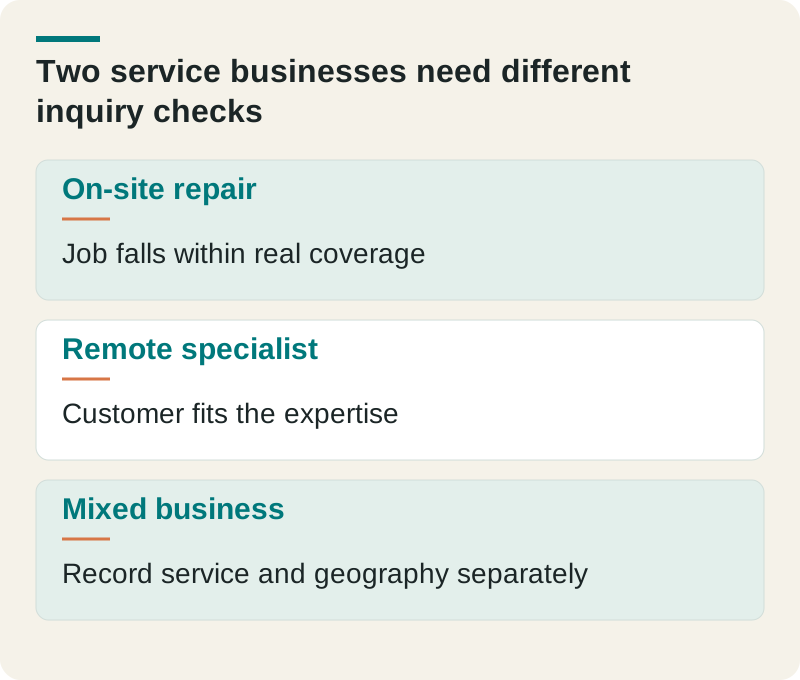
- On-site repair
- Job falls within real coverage
- Remote specialist
- Customer fits the expertise
- Mixed business
- Record service and geography separately
Write these qualification rules before comparing local and organic traffic. Keep eligible Business Profile activity separate from website search results where the reports differ. Use the accepted inquiry record to judge customer fit instead of treating every contact click as demand the business can serve.
Check this before you proceed
- State the real delivery boundary.
- Record why an inquiry fits or does not fit.
- Use distinct pages only for distinct useful information.
Download this article’s editable worksheet (CSV). Add your evidence, owner, and review date. For the next related decision, read Google Business Profile Audit: Check the Path to a Real Inquiry.
Your next step
Pick one service and one customer group. Compare their actual buying journey with your current website and intake process. Write down the largest gap you can explain with evidence.
Use this brief to compare SEO proposals against the same customer, service area, and desired outcome. If you want help identifying the first priority, explore The Operations Guide’s SEO Growth Partnership. Its Foundation SEO Assessment reviews current visibility and turns the findings into a roadmap for the work ahead. Bring the one-page brief to that conversation.
Frequently asked questions
Can a business use local and organic SEO together?
Yes. A local business can benefit from useful website content alongside its eligible local presence. Assign each activity a purpose and measure inquiries against the service you can deliver.
Does local SEO remove the need for a website?
No. Prospects may still visit your site to understand the service, check fit, and contact the team. The amount of website work depends on those needs and the quality of the current site.
Should we publish city pages first?
Only when each page serves a real customer need with accurate, distinctive information. Start with the actual service coverage and offer. A list of target cities is not a content brief.