Most portal demonstrations show a tidy dashboard, a document list, and a friendly welcome message. Those screens rarely decide whether the portal will work for your business.
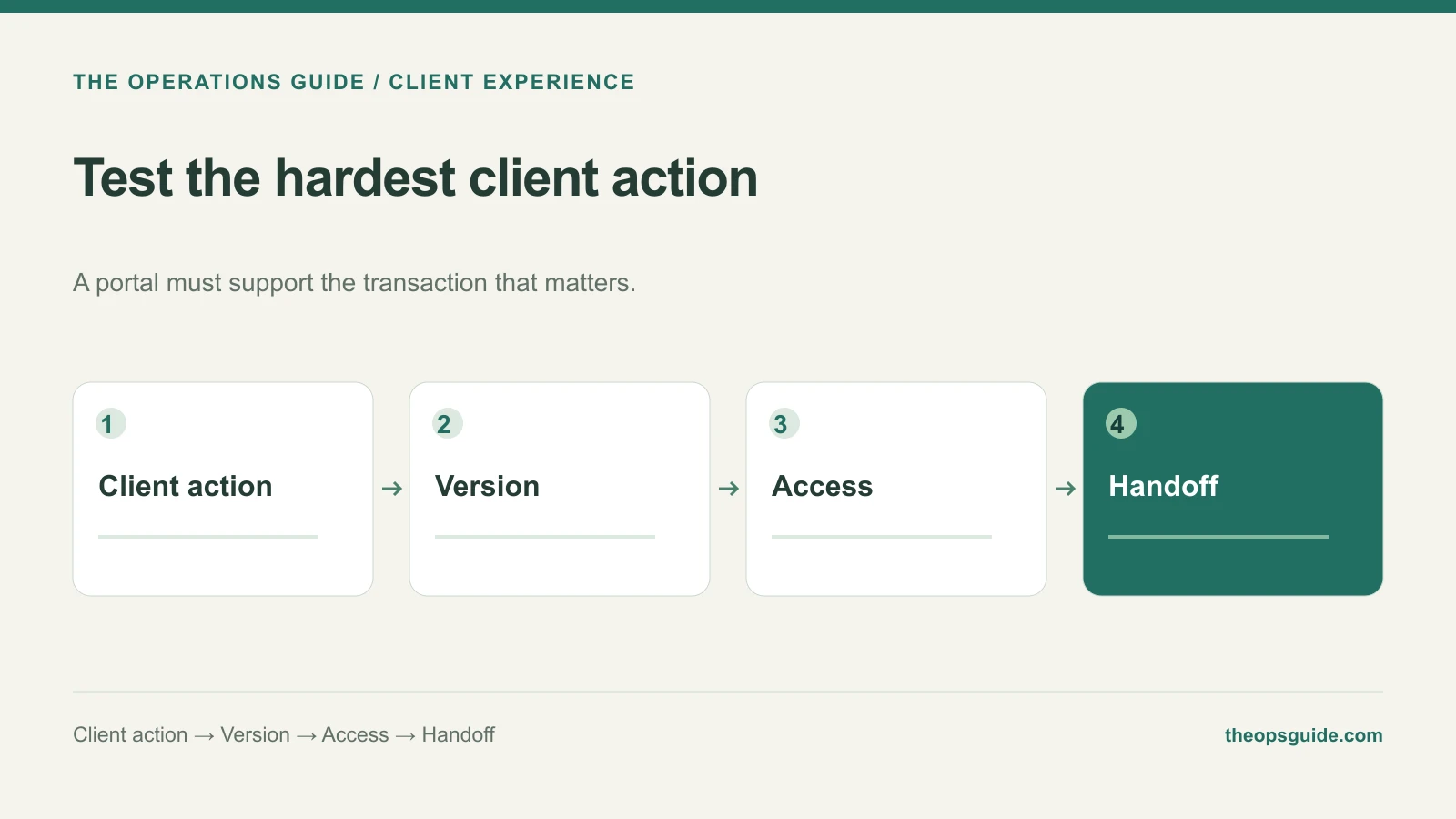
The decisive test is often a client action: approving a specific version, supplying a missing document, disputing a charge, or inviting a colleague without exposing another customer's records. Start there.
Write the action as a complete transaction
Imagine a design firm that needs a client to approve version three of a deliverable before production starts. A useful requirement is more specific than “clients can approve files.”
The approval must refer to the exact version the client reviewed. A replacement file should not silently inherit the old approval. The delivery team needs to see who approved it and when, and the client needs to understand what happens next.
That short scenario gives you a better product test than a broad feature checklist.
Run the same scenario in every option
| Test | What you want to observe |
|---|---|
| Client opens the current file | The version and requested decision are clear |
| Client approves it | The decision attaches to that version |
| A revised file is uploaded | The earlier approval remains distinguishable |
| A colleague is invited | Access follows the intended customer boundary |
| Delivery checks the result | The team can find the approved item without retyping it |
| The business exports its records | Files and decision history remain usable |
Use accounts with the permissions real clients would receive. An administrator's demonstration does not establish what a customer can see or do.
Buy the fit you can demonstrate
An existing product is attractive when it handles the important transaction cleanly and the remaining configuration is manageable. You inherit a product's development and support, while accepting its model for permissions, records, and integrations.
A custom portal may be justified when the missing action is central to the service and workarounds would undermine it. Custom work also brings responsibility for access controls, maintenance, account recovery, and changes to the systems it connects to. A custom logo and homepage alone are a weak reason to assume those obligations.
Do not accept “we can integrate that” as the final answer. Ask to see the exact information that crosses the boundary, what happens when the connection fails, and who owns the repair.
Price the exceptions before the build
List the cases that interrupt the normal path: a withdrawn approval, an incorrectly invited user, a client who changes companies, or an archived project that must be reopened. Agree which belong in the first release.
Keep the initial portal focused on the client transaction and the staff handoff it supports. Internal accounting, resource planning, and every historical document do not automatically need to move into it.
If an existing product passes the important tests, configuring it may be the best investment. If it fails at the action that defines your service, The Ops Guide can help scope a custom portal around that gap.