
You have room for twelve more service jobs next month. Your website also has weak descriptions of the services you want customers to find. Advertising and SEO address different parts of that problem, and the business may not be ready to fund both at full scale.
Decide what your next investment must accomplish and when. Then check whether your website and team can convert the additional inquiries into work you can fulfill.
Start with the constraint behind the budget
If you need near-term inquiries for a service people already search for, a limited paid campaign may let you test demand and messaging. The campaign still needs suitable targeting, a useful destination, and a way to identify qualified inquiries.
If customers cannot understand your service or the inquiry form fails, fix that path before adding traffic. Those improvements can support both channels. If your priority is building useful organic coverage over time, SEO work may fit, provided the team can supply accurate service details and maintain the pages.
Google states in its SEO hiring guidance that buying Google advertising does not improve organic rankings. Price the paid and organic work as separate investments rather than expecting ad spend to lift unpaid results.
Run the paid scenario with your own economics
The following numbers are hypothetical. A repair company sets a $1,000 media test budget and incurs another $500 for campaign setup and landing-page work. At an assumed $10 per click, the media budget buys 100 clicks.
If ten visitors submit inquiries, six fit the service and area, and three become completed jobs, the total test cost is $500 per acquired job: $1,500 divided by three. If contribution per job after delivery costs is $400, those three jobs contribute $1,200 against the $1,500 test cost.
Under these assumptions, the test does not recover its cost during that period. A higher booking rate or greater contribution could change the result. A lower click price alone would not solve irrelevant inquiries or a team that cannot answer them.
| Change to the hypothetical test | Implication |
|---|---|
| Only two completed jobs | $750 acquisition cost per job |
| Four completed jobs | $375 acquisition cost per job |
| Jobs exceed available capacity | Stop expanding spend until fulfillment is workable |
Give SEO a different investment test
You cannot assume an SEO article will buy a predictable number of visits next week. Define the work you are funding: repair key templates, strengthen an established service page, or answer a specific customer question the site currently misses.
Compare the cost of completing and maintaining that work with the organic opportunity you can observe. Search Console can show queries and pages already receiving exposure; customer conversations can reveal questions visitors need answered. Neither source supplies a guaranteed traffic forecast.
Use a longer observation window appropriate to when changes went live. Keep measurement of qualified leads consistent with the paid test. Otherwise you may compare organic visits with paid bookings and conclude that one channel won using different outcomes.
Calculate break-even jobs before expanding the test
For the article’s hypothetical campaign, divide the $1,500 total test cost by $400 contribution per completed job. The result is 3.75, so four jobs are needed to cover the test cost. Three jobs leave a $300 shortfall; four leave $100 before any costs excluded from the model.
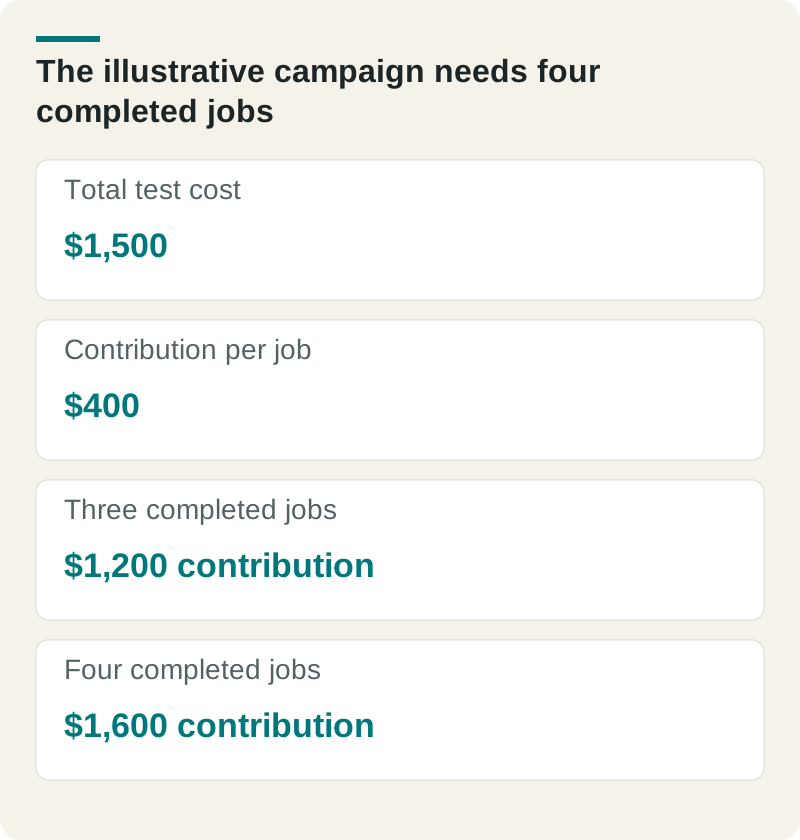
- Total test cost
- $1,500
- Contribution per job
- $400
- Three completed jobs
- $1,200 contribution
- Four completed jobs
- $1,600 contribution
Check whether contribution already includes fulfillment costs and whether cancellations or refunds change the completed-job count. This is a planning calculation, not a forecast of ad performance. SEO needs its own observation window and useful-output test rather than an invented cost-per-click equivalent.
Check this before you proceed
- Include setup and landing-page costs.
- Use completed jobs rather than raw inquiries.
- Check available delivery capacity.
Download this article’s editable worksheet (CSV). Add your evidence, owner, and review date. For the next related decision, read How to Measure SEO Leads Beyond Rankings and Traffic.
Choose a sequence your team can support
For the repair business, a sensible first phase could fix the inquiry path and clarify the service page, then run a capped ad test while beginning a small organic content plan. Another business with a full appointment book may prioritize organic improvements for a coming expansion instead of buying more inquiries now.
Our guide to measuring SEO leads helps define useful outcomes. Explore The Ops Guide's SEO services if you need the organic work scoped around your service, capacity, and buying goals.