
A visitor reaches your bookkeeping cleanup page with three years of unreconciled transactions. Your headline says “financial solutions,” the copy lists five services, and the button asks them to book a consultation. They still do not know whether you handle their problem.
Write the page around that buying decision. Search relevance helps the right visitor arrive; the page must then explain the work they can purchase and what the provider needs to begin.
Choose one buying need for the page
For this hypothetical bookkeeping business, the cleanup page serves owners with historical records that need reconciliation and correction. Ongoing monthly bookkeeping belongs on a different service page. Payroll stays out of the promise because the business does not provide it.
If you have not assigned these buying needs, use our service-page keyword mapping guide first. Once you know what this page owns, stop expanding it to cover unrelated searches.
A service-page outline with useful detail
| Page section | Illustrative content |
|---|---|
| Opening | Bookkeeping cleanup for owners with unreconciled past transactions |
| Who it fits | Existing records need review before the next reporting or tax-preparation step |
| Included work | Review the agreed period, reconcile identified accounts, document unresolved items |
| Limits | Tax filing and payroll are outside this scope |
| Evidence | A permissioned, dated example of the work delivered |
| Next step | Request a scope review with the period and software you use |
The example describes a possible page structure, not an offer from The Ops Guide. Replace each line with facts the service team can honor. If the team cannot agree on included work, resolve that gap before polishing the copy.
Explain the output the buyer receives
“We bring clarity to your finances” gives the visitor little to compare. “You receive reconciled records for the agreed period and a list of unresolved items requiring your accountant's decision” identifies a usable output.
Add the inputs that change scope: number of accounts, available statements, missing records, and the period requiring review. You can ask for those details at the next step instead of publishing a misleading one-size price or turnaround.
Keep operational instructions short. The page needs enough detail for a buyer to decide whether to inquire, not the provider's entire internal procedure. A deeper article can answer a preparatory question if the visitor needs it.
Use proof that supports the actual promise
A general five-star testimonial does not prove a particular cleanup result. Use an approved example describing the starting issue, work completed, and measurement period. Protect private records, and explain whether a figure refers to corrected items, staff time, or a financial result.
Place that evidence near the claim it supports. On mobile, a brief result with a link to the full case study can work better than a long story interrupting the buying flow. Do not borrow a different service's success to imply a guaranteed outcome here.
Google's SEO starter guide recommends useful, readable content. A clear page can satisfy that advice without repeating the same phrase in each heading.
Run a five-minute reader test on the outline
Ask someone unfamiliar with the business to read the service page on a phone, then describe who it fits, what they receive, and what happens after the button. Do not explain the offer first; the page needs to do that work itself.
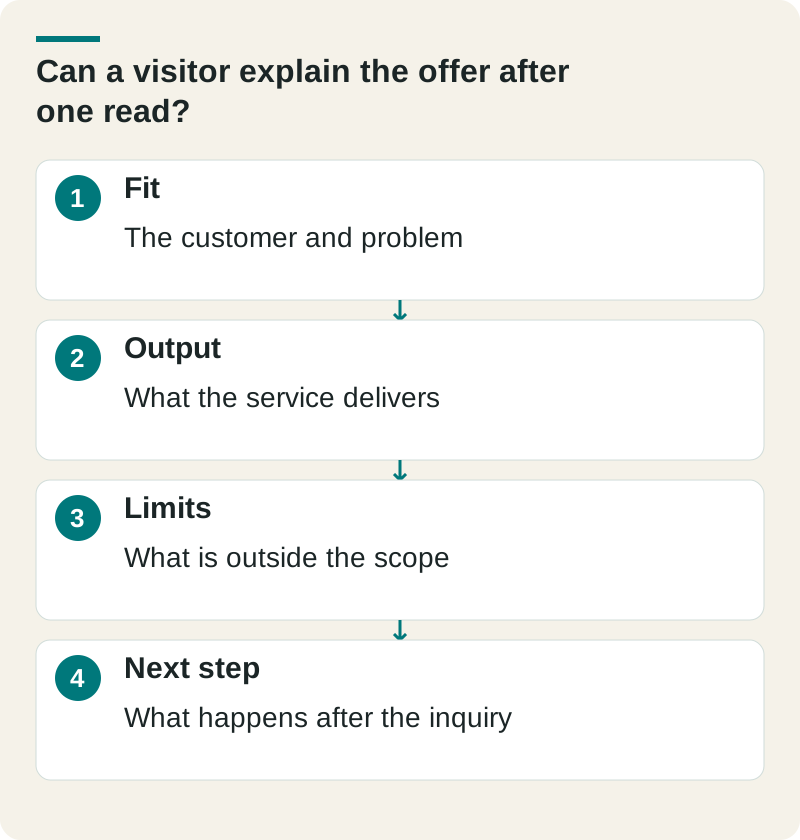
- Fit
- The customer and problem
- Output
- What the service delivers
- Limits
- What is outside the scope
- Next step
- What happens after the inquiry
For the hypothetical cleanup service, a reader should distinguish historical bookkeeping cleanup from ongoing bookkeeping and tax filing. Rewrite the unclear section before adding more keywords. Test the contact path after the copy revision so useful information leads to a working next step.
Check this before you proceed
- Use a reader unfamiliar with the offer.
- Check that scope limits remain visible on mobile.
- Verify the inquiry reaches its intended owner.
Download this article’s editable worksheet (CSV). Add your evidence, owner, and review date. For the next related decision, read Keyword Mapping for Service Pages: Give Each Buying Need a Home.
Test the next action as a customer
Ask someone unfamiliar with the service to read the page on a phone and explain who it fits, what they receive, and what happens after the button. If they answer “book a call about anything,” sharpen the scope and next-step wording.
Then complete the inquiry with a safe test. Confirm the successful submission reaches the right person and gives the visitor a truthful expectation of what follows. More traffic will not repair a broken handoff.
For help connecting service-page content to the customers you want to reach, discuss managed SEO services with The Ops Guide.