
Your team can prepare supplier packets in minutes with AI. The approval queue has grown, and customers still wait three days for a response. Buying a faster model may increase the number of packets waiting for the same reviewer.
Follow the work through its next handoff before improving the AI step again. You need to know how much ready work arrives, how much the next stage finishes, and what causes an item to return for correction.
The September 2026 revision of the NBER paper Writing Code vs. Shipping Code reports that coding-activity gains attenuate across later production stages. Its matched observational analysis concerns software developers, not supplier approvals. The relevant management question is worth checking in your own workflow: does faster preparation lead to more completed work?
Draw the queue using one common unit
Consider this hypothetical supplier-onboarding process. The team counts complete packets, rather than pages generated or prompts used.
| Weekly stage | Before the change | After the AI preparation step |
|---|---|---|
| Packets ready for review | 20 | 35 |
| Packets the review stage can finish | 25 | 25 |
| New queue growth | None from this imbalance | 10 packets per week |
If those rates persist with no backlog clearance or withdrawals, the queue adds 40 packets over four weeks. This is arithmetic for an invented example, not an observed business result. It makes the next choice visible: additional preparation capacity cannot remove the review constraint.
Inspect what consumes the next stage
The reviewer spends time on three kinds of work: confirming complete routine packets, chasing missing documents, and deciding exceptions. Those tasks need different remedies.
If missing documents consume the time, improve the preparation checklist and route incomplete packets back before review. If exceptions consume it, decide which questions require the reviewer and which can follow an agreed rule. If complete packets still exceed capacity, consider changing the release rate or assigning suitable review time.
Do not treat the time spent checking a consequential decision as waste. A supplier approval may commit the company to terms or grant access. The objective is a workable flow with the required quality, not a queue chart that falls because the team skipped its obligations.
Choose a bounded change at the constraint
In the example, ten of the 35 packets arrive without a required document. The team first changes intake so those ten stay in a preparation queue with an explicit request to the supplier. It tests whether the 25 complete packets fit the existing review stage.
That change is a hypothesis. If the reviewer still finishes only 18 because the complete packets are more complex, the original capacity estimate was wrong. Update the plan using the observed task mix rather than forcing the numbers to match.
The team can also throttle preparation to match customer priority. Define which suppliers must complete onboarding this week and hold low-priority work until the review stage can accept it. Extra generated output has little value if it will become stale while waiting.
Model what happens to the queue over four weeks
Using the article’s invented rates, 35 arrivals minus 25 completions adds ten packets to the queue each week. Over four weeks, that is 40 additional waiting packets if the rates hold and nothing leaves through another route. Faster preparation increases the pressure on the same reviewer.
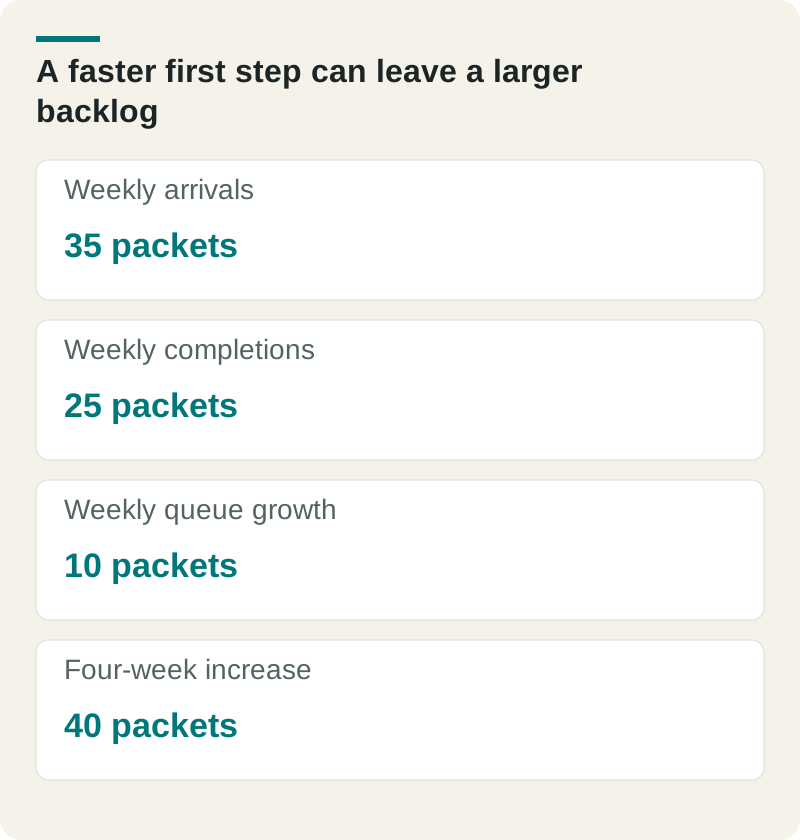
- Weekly arrivals
- 35 packets
- Weekly completions
- 25 packets
- Weekly queue growth
- 10 packets
- Four-week increase
- 40 packets
Inspect the mix of complete and incomplete packets before adding capacity. Moving missing-document requests into a separate preparation queue may help, but it needs measurement. Track waiting time and accepted completions together so improved throughput does not hide a growing backlog.
Check this before you proceed
- Use one common unit for arrivals and completions.
- Count missing-information work separately.
- Recalculate when the task mix changes.
Download this article’s editable worksheet (CSV). Add your evidence, owner, and review date. For the next related decision, read Write Dashboard Requirements Around a Decision Someone Has to Make.
Check completion and waiting together
For two weeks, track completed approvals, the age of the oldest ready packet, and the reason for returns. Increased completions with stable quality supports continuing. Fewer waiting packets caused by abandoned requests requires a different interpretation.
Keep the broader release checks in our pilot-to-production guide. If AI improvements are creating competing capacity decisions across teams, The Ops Guide's fractional CAIO services can help you choose the next operating change.