
Your monthly AI meeting ends with the same instruction: keep exploring. Three teams leave with permission to experiment, but nobody knows which work gets implementation time or when the business will decide to stop paying for it.
Give the review one concrete job: decide what receives resources before the next meeting. Updates matter when they help leaders continue, narrow, stop, or expand an initiative.
McKinsey's 2026 State of AI survey associates reported high performance with senior-leadership commitment and defined impact measurement. Those self-reports do not prove that a meeting format or a CAIO title causes results. They support asking whether leaders connect reported progress to actual choices.
Bring the choice into the room
Use a short decision paper for each initiative requiring funding. Include the current scope, what the team has observed, ongoing costs, unresolved constraints, and the exact resource request. Have the operating manager and person doing the work review it before the meeting.
The following fictional review concerns AI-assisted supplier-document processing. The finance manager has tested ordinary documents but still reviews amended orders by hand. A sales-proposal pilot competes for the same implementation team.
| Agenda item | Evidence or question | Decision required |
|---|---|---|
| Supplier documents, 10 minutes | Ordinary orders meet the agreed quality check; amendments still need review | Continue the narrow scope or expand document types? |
| Operating capacity, 5 minutes | Finance has six review hours available next week | Fund review time before adding volume? |
| Sales proposals, 5 minutes | Team has no approved pricing source | Defer build or accept a manual preparation task? |
| Commitments, 5 minutes | Confirm the decision and revisit condition | Assign spending and delivery responsibility |
Record one funded decision in full
The sponsor approves two weeks of the existing supplier-document scope, with an illustrative $800 tool-and-support cap and six finance review hours each week. The team keeps amendments in the manual queue. The implementation lead will add a visible exception reason so reviewers can sort that queue.
Finance will review the accepted ordinary orders and unresolved exceptions before the next meeting. Expansion requires evidence that the amendment workflow fits available review capacity. The sponsor can end the continuation if the tool writes critical fields without the agreed check.
These figures and conditions are hypothetical. The useful detail is the bounded commitment: leaders have funded a particular operating mode and identified the evidence needed for a different mode.
Give deferred work a condition for returning
The sales proposal pilot gets no implementation allocation this month. Its manager must first supply an approved pricing source and decide who can authorize an exception. The executive team agrees to revisit the pilot when those two inputs exist.
That decision protects the delivery team from parallel requests that lack the prerequisites to finish. “Defer” should include a reason and return condition; otherwise people spend the next month lobbying for the same incomplete proposal.
Keep a separate list of choices the sponsor declined. A tool renewal or expanded data permission should not slip through because the agenda discussed only interesting new pilots.
Record what the next funding decision depends on
For the article’s hypothetical supplier-document trial, record the approved work, spending cap, review hours, and excluded amendments in one decision note. The review date should ask whether those boundaries produced a useful result, not whether the team remains interested in AI.
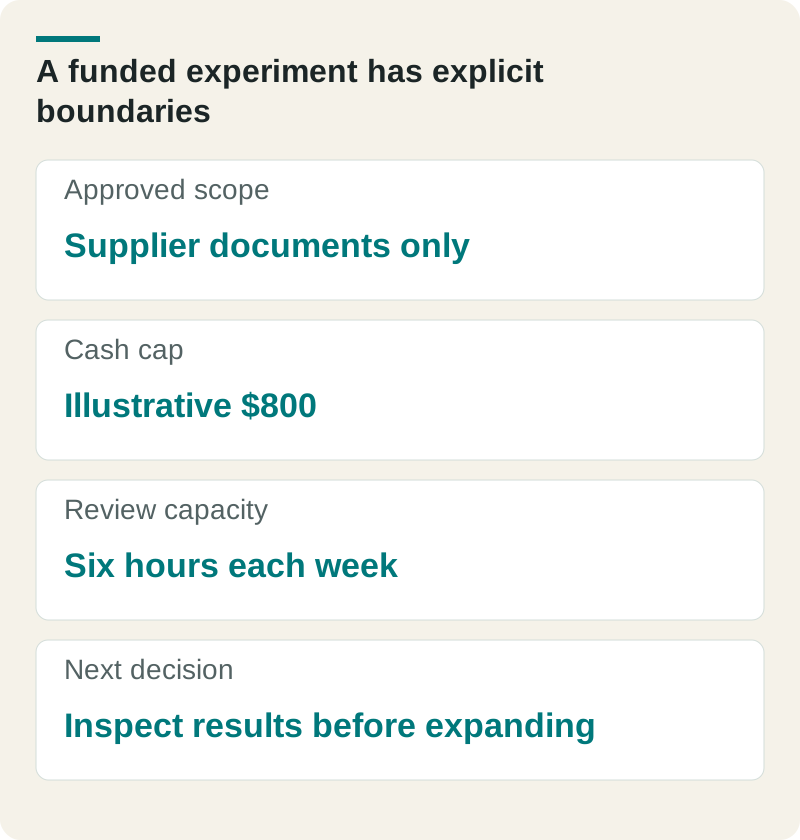
- Approved scope
- Supplier documents only
- Cash cap
- Illustrative $800
- Review capacity
- Six hours each week
- Next decision
- Inspect results before expanding
Keep unspent budget separate from unused staff capacity. The team can stay under the software cap and still overwhelm finance with corrections. Inspect both costs and completed work before approving the next phase. Deferred ideas should have a concrete condition for returning to the agenda.
Check this before you proceed
- Name the sponsor making the decision.
- Record the stop condition.
- Compare the next request with the approved scope.
Download this article’s editable worksheet (CSV). Add your evidence, owner, and review date. For the next related decision, read Your AI Step Got Faster. Why Is the Work Still Waiting?.
Make the next meeting accountable to this one
Open the following review with the prior commitments. Ask what the funded scope delivered, what it cost to operate, and whether the original condition for expansion now holds. Change the plan when the evidence changes rather than defending last month's choice.
Our AI strategy roadmap guide covers the broader sequence of initiatives. The Ops Guide's fractional CAIO services can help leaders bring these operating choices to a clear decision and keep the agreed work moving.