
You sign an SEO agreement and receive a reassuring report: research is complete, recommendations are in progress, and the team is monitoring performance. You still cannot tell what changed on your website.
Agree on observable checkpoints before the engagement starts. Rankings may not give you a useful signal during the first few weeks. You can still inspect the starting evidence, completed work, and obstacles your provider needs your team to remove.
Use milestones that someone can inspect
This fictional 90-day plan concerns a local repair company with three established service pages and an unreliable inquiry form. It illustrates acceptance discussions, not a delivery promise from The Ops Guide.
| Checkpoint | Evidence to inspect | Decision |
|---|---|---|
| Day 30 | Agreed starting URL list, verified inquiry event, affected-page repair list | Approve repairs and supply missing access |
| Day 60 | Repaired form, revised service pages, published change log, remaining exceptions | Accept completed work; resolve one developer dependency |
| Day 90 | Search and inquiry trends for the agreed pages, qualification notes, unresolved work | Continue the current focus, change scope, or pause |
The provider should show you the actual pages at the second checkpoint. A task marked complete can mean a ticket closed, a draft approved, or a production change tested. Agree on which event counts as delivery for your scope.
At day 30, you can verify that your inquiry measurement distinguishes a successful submission from a button click. You do not need a large volume of leads to test that behavior. At day 60, you can try the form on mobile and confirm that the right person receives the inquiry.
Keep client dependencies visible
In the example, the provider cannot publish the replacement heating-service description until the owner confirms which equipment the team repairs. Meanwhile, the developer waits for permission to change the booking integration.
Record those delays with the requested action, accountable person, and effect on the milestone. “Waiting on client” is too broad to help anyone. “Owner to confirm supported equipment by Friday; service-page publication depends on that answer” tells your team what to do.
Distinguish a reasonable dependency from an empty work plan. The provider can still complete the other approved pages, test the current inquiry path, and prepare the implementation instructions. At the review, ask what moved despite the blocked item.
Judge early results without inventing a success threshold
Google's SEO starter guide explains that search changes can take weeks or months to show an effect. A 90-day date cannot guarantee a ranking or lead result.
Review the same agreed pages and periods, and note when meaningful changes went live. A newly published page has a shorter observation window than a repaired page that existed before the engagement. Avoid comparing the two as though they received equal exposure.
Use inquiry qualification alongside visibility. A repair business may gain searches for equipment it does not support. That finding calls for a content or targeting adjustment even when the impression chart rises. A quiet chart with confirmed repairs may justify more observation, but the provider should explain the next hypothesis and its cost.
Use a milestone that can fail honestly
If the repaired inquiry form still fails a safe mobile test at day 60, the milestone has not been met even if the task is marked complete. Record the failed behavior and the owner of the repair. A candid exception gives the next review something useful to resolve.
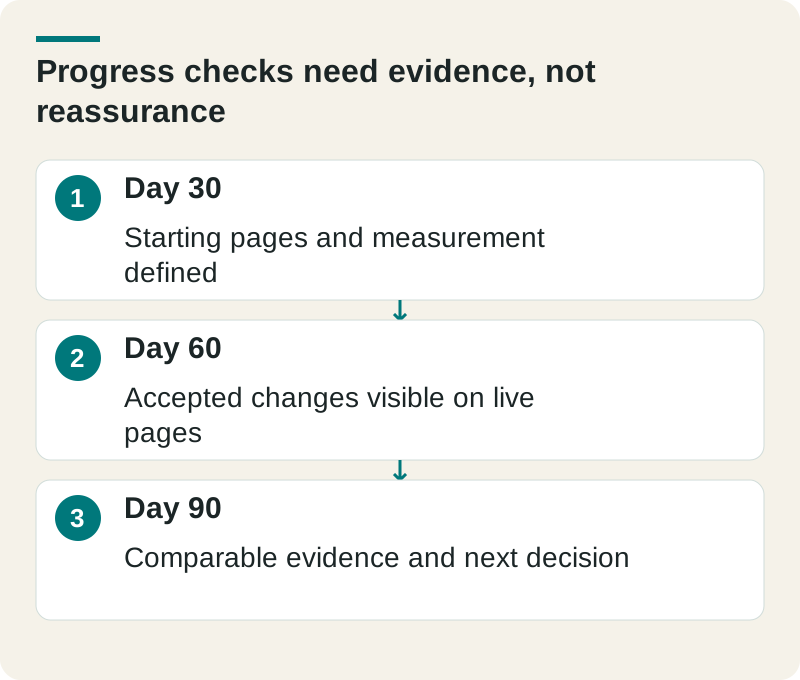
- Day 30
- Starting pages and measurement defined
- Day 60
- Accepted changes visible on live pages
- Day 90
- Comparable evidence and next decision
Search exposure can lag implementation. Keep a confirmed repair separate from an unproved traffic outcome, and label short observation windows. At day 90, decide whether the completed work, remaining dependencies, and customer opportunity justify continuation.
For example, my ActionVFX case study, from my time as COO, reports 4,614 on-page issues resolved and an audit score moving from 40 to 72. Those measures describe the audit result. They do not establish a traffic or revenue increase. Ask your provider to make that same distinction when presenting the first quarter’s work.
Check this before you proceed
- Keep the agreed starting URL list.
- Record the live date of each material change.
- Explain unresolved dependencies individually.
Download this article’s editable worksheet (CSV). Add your evidence, owner, and review date. For the next related decision, read An SEO Report Template That Ends With a Decision.
End the quarter with an actual choice
Continue if completed work supports the buying needs you agreed to pursue and the next phase has a defensible purpose. Narrow the scope if approval or implementation capacity limits delivery. Pause if the team cannot explain the changes, measurement remains unreliable, or the proposed next work has no connection to your customers.
Bring the checkpoint plan to your kickoff. Our SEO reporting template can support the review.
Want to see what the first 90 days look like with The Ops Guide? See how the SEO Growth Partnership is structured.