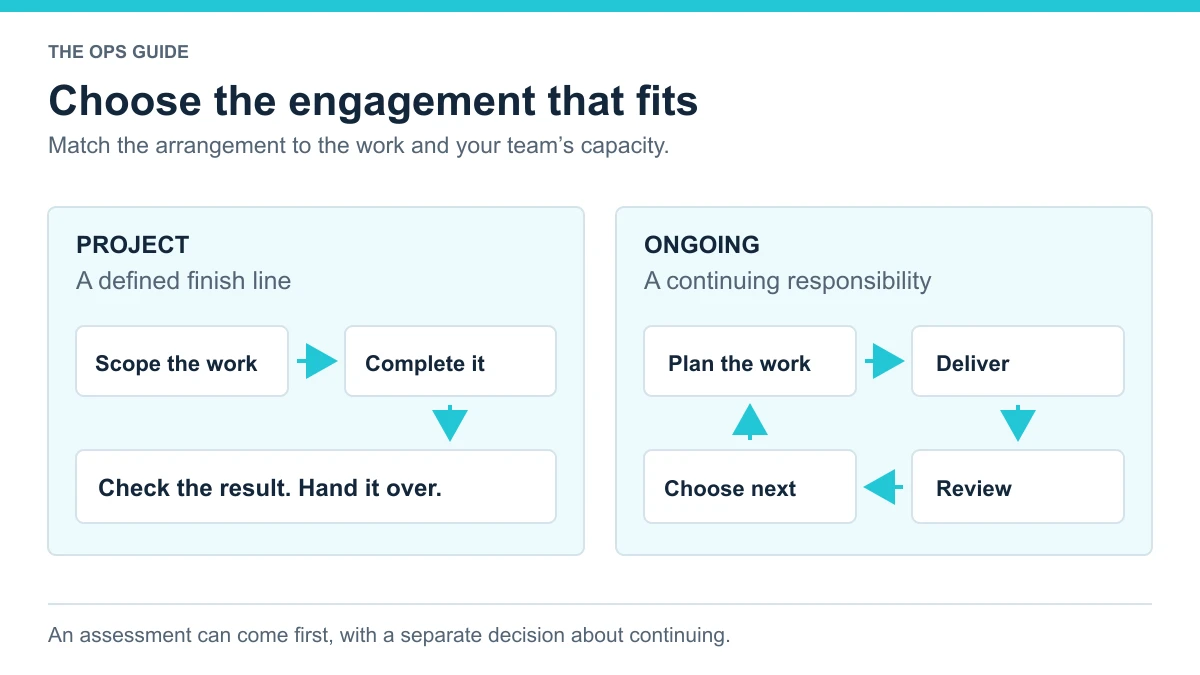
Your website needs attention, and two providers suggest different arrangements. One proposes a project with a completion date. The other recommends a monthly engagement. Comparing the fees alone will not tell you which one fits.
Start by describing the work you need someone to finish. Then identify the decisions and tasks that will remain after that work ends. A project can suit a bounded repair or assessment. A recurring engagement can suit continuing production, review, and improvement that your team wants someone else to carry through.
You can also buy the initial project and make the ongoing decision after you understand the findings. Put that decision point in the agreement.
Give the project a finish line
Imagine a fictional equipment maintenance business preparing to replace its website. The company has an internal marketer and a developer. It wants an SEO specialist to help preserve useful service pages through the launch.
A finite project could cover the current-page inventory, agreed preservation decisions, review of the replacement site, and a defined set of checks after launch. The marketer can maintain content once the specialist hands the work over.
The company should describe completion in terms the participants can verify: the developer implemented the agreed redirects, the specialist checked the named pages, and the team received the unresolved-issue list. The redesign SEO checklist provides the detailed preservation questions.
A completed project does not settle future content needs or guarantee search performance. The buyer still needs someone to notice changes and decide when to bring the specialist back.
Give the retainer a continuing job
Now imagine a different company offering commercial cleaning across several service categories. Its owner can explain the work, but nobody on staff has time to choose useful article subjects, turn expertise into finished content, manage approval, publish, and review search activity.
That company has a recurring capacity need. A monthly engagement can give the work a delivery rhythm and a person responsible for moving it forward.
The owner still needs to name priorities and approve service details. The agreement should also identify any website changes that require separate development work. Our monthly SEO scope guide shows how to make those responsibilities concrete.
The reason to continue is the useful work ahead and the capacity to complete it. “SEO takes time” leaves too much unanswered about what the provider will do during that time.
Compare the work before choosing the payment pattern
Use this table to prepare for a scoping conversation. These are buying considerations, not rules that force a particular contract.
| Your situation | Arrangement worth considering | Detail to settle before signing |
|---|---|---|
| You need an assessment before deciding what to change. | A defined assessment project. | Deliverables, evidence, handoff, and who will implement the findings. |
| You have a known repair and someone can maintain the result. | A fixed-scope implementation project. | Affected pages, completion checks, follow-up window, and exclusions. |
| You need ongoing content and have an available subject expert, but no publishing capacity. | A recurring content and SEO engagement. | Production cadence, review responsibilities, publication, measurement, and change requests. |
| You have a capable internal team that needs occasional specialist help. | A project or scheduled review appropriate to the need. | Preparation, specific decisions, and the trigger for another review. |
| You expect continuing work but cannot describe it yet. | An initial assessment with a separate continuation decision. | What evidence and backlog will justify the next commitment. |
Ask both providers to respond to the same situation. Comparing an audit-only project with a retainer that includes production and publication will otherwise obscure the difference in what you receive.
Write the decision as a short buying brief
Use these fields before you approve either arrangement:
- Work we need: Name the pages, service, or customer question involved.
- Completion we can verify: Describe what the provider will deliver and how your team will accept it.
- Work that continues afterward: List the recurring tasks that remain.
- Internal capacity: Name who can handle those tasks and the time they can commit.
- Additional spending: Identify separate implementation, tools, and staff effort.
- Next decision: Choose the date or business event when you will review the arrangement.
For the maintenance company's redesign, a completed brief might conclude: “Buy the migration review as a project. Our marketer owns content after launch; our developer handles site changes. Reassess when we add a new service or plan another major website change.”
For the cleaning company, the conclusion might be: “Start with an assessment, then agree on recurring article production and publishing. Our operations lead will supply expertise and approve drafts. Review the topic direction and available capacity at the agreed renewal point.”
Those conclusions follow from different staffing needs. Neither requires an invented traffic forecast.
Make ending or continuing part of the scope
For a project, ask what files, access records, and working notes your team receives. Define the follow-up period and the process for work outside the original brief.
For a retainer, confirm the minimum commitment, notice requirements, treatment of unfinished drafts, and handoff responsibilities. Ask how the provider will propose a change in scope when your priorities change. Discuss the commercial terms before assuming a monthly invoice means you can cancel at any time.
The Ops Guide's SEO offering begins with a Foundation SEO Assessment and provides ongoing content options at four or eight articles per month. The assessment informs the continuing work. Bring your business priorities and internal capacity to a discovery conversation so the proposal can address the work you need help completing.