You approve a monthly SEO fee. Four weeks later, you receive a report, two drafts, and a request to ask your developer about several fixes. You still need to know which work the fee covered and which work your team must finish.
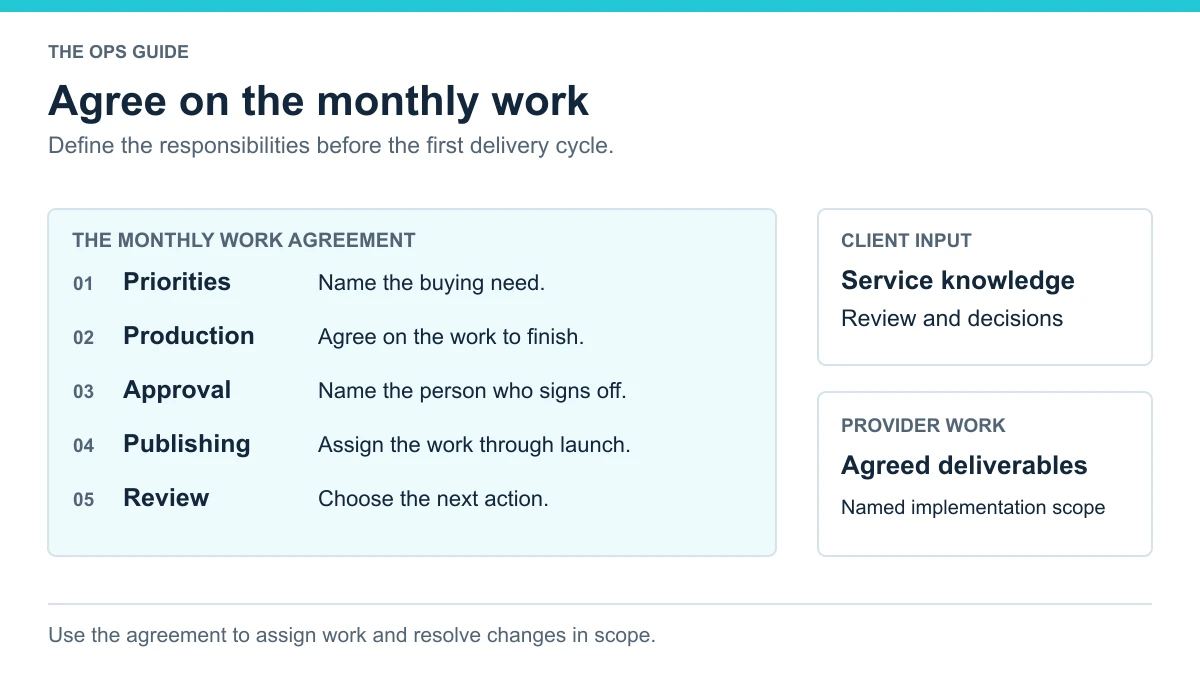
A useful monthly agreement answers that before work starts. It names the recurring responsibilities, the deliverables your provider will complete, and the decisions your team must make. It also explains how you change the plan when the business needs something different.
Start with the work your business can use this month. Then agree on a repeatable way to choose, complete, and review it.
Name the reason for the recurring work
“Improve SEO” gives you too little to approve. Your business might need more visibility for a service with available capacity, better information for customers comparing options, or fewer inquiries for work you do not offer.
Write one sentence that connects the engagement to that need. For example: “Help property managers understand our commercial maintenance service and send requests that fit our coverage area.”
Your provider can use that sentence to challenge a proposed article, page change, or local listing update. Your team can use it to explain why an attractive topic belongs outside the current plan.
The initial assessment should identify your starting position and the work ahead. Our SEO audit deliverables guide covers that purchase. A monthly agreement should explain what happens after you accept the findings.
Separate recurring responsibilities from this month's deliverables
Monitoring, topic planning, writing, publishing, and measurement involve different work. A provider can include one without including all of them. Ask them to describe the handoff between each step.
Use this example to review a proposed agreement. The company and commitments below are hypothetical; they illustrate a scope you can adapt.
| Part of the agreement | Completed example for a commercial maintenance company |
|---|---|
| Business priority | Help property managers judge whether the maintenance service fits their building and location. |
| Recurring review | Provider reviews relevant search activity, existing content, and local listing changes before proposing the next month's work. |
| This month's production | Provider prepares four approved articles answering distinct maintenance buying questions, including images and publishing preparation. |
| Customer expertise | Operations manager supplies service exclusions and checks technical claims within five working days of receiving each draft. |
| Publication | Provider publishes after the named manager approves the article. Silence does not count as approval. |
| Website changes | Provider can edit agreed content areas. The client commissions changes to the booking integration under a separate scope. |
| Completion record | Provider records the published URL, approval date, publication date, and any unresolved publishing or indexing observations. |
| Next decision | Owner and provider review inquiry fit and the work completed, then choose whether to continue the topic direction or change it. |
A different business might need fewer articles and more work on existing pages. Ask for the arrangement that addresses the need you identified. Article count tells you how much production you bought; it does not establish whether the proposed subjects deserve separate pages.
Put implementation capacity in writing
Take one likely recommendation and follow it through. Suppose your provider finds that a service page needs clearer coverage information. Someone must confirm the territory, revise the copy, approve it, edit the page, and check the result.
Ask which of those actions your fee includes. If a developer must change the page template, identify who will brief that developer and whether the quote includes their time.
Then discuss competing work. An urgent repair may consume the time set aside for content. Agree whether the provider will replace an item, request an extra budget, or move the delivery date. Record the choice before the team starts the additional work.
This prevents a recurring argument about whether “website optimization” includes anything someone finds wrong with the site.
Agree on what your team must supply
Your provider needs accurate information about your services. Name the person who can answer questions about availability, exclusions, customer examples, and claims that need evidence.
Give that person a review window they can meet. If approval stalls, ask the provider to identify the blocked item and the effect on the schedule. Agree how unused production capacity carries forward, expires, or gets reassigned. Providers handle these arrangements differently; the proposal should state yours.
Keep account ownership and access visible too. Your business should know who controls the website, search accounts, content files, and approval record if the engagement ends.
Use the monthly review to choose the next work
Ask for a short discussion of completed changes, observed results, and the next decision. Our SEO report template provides a format; the monthly scope should specify who prepares it and who acts on it.
Agree on what counts as an SEO lead before using inquiry totals to judge progress. If the business receives unsuitable requests, bring that detail into the next planning conversation.
The Ops Guide's SEO service starts with a Foundation SEO Assessment, followed by ongoing work. Core includes four articles per month; Boost includes eight. Both include topic planning, article production, client approval, publishing, indexing checks, and performance measurement. Discuss implementation boundaries and your team's responsibilities when shaping the proposal.
Bring a current business priority to that conversation, along with the work your team can handle. You can then agree on a monthly scope that someone has the capacity to complete.