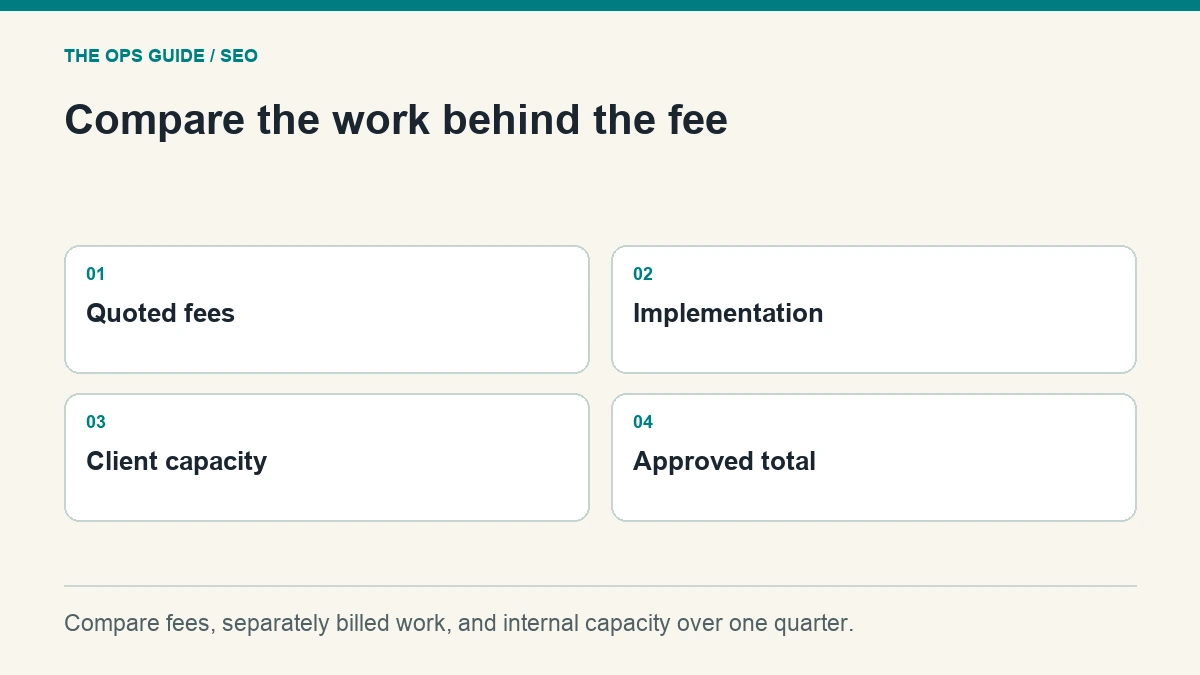
One SEO proposal costs $1,200 a month. Another costs $2,000. The first looks cheaper until you discover that your developer must carry out every recommendation and your office manager must write the pages.
Before choosing, price the same piece of work over the same period. You need a view of cash leaving the business, staff time required, and work each provider excludes. A list of deliverables alone leaves too much room for different assumptions.
Put two hypothetical quotes on the same footing
Consider a service business choosing between two invented proposals for its first quarter. These numbers illustrate the comparison; they are not market rates or The Ops Guide pricing.
| First-quarter item | Quote A | Quote B |
|---|---|---|
| Setup | $600 | Included |
| Three monthly fees | $3,600 | $6,000 |
| Approved developer work | $1,800, billed separately | Included within the listed repair scope |
| Two service-page revisions | $900, separate writer | Included |
| Expected cash outlay | $6,900 | $6,000 |
| Client preparation and approval | 18 staff hours | 8 staff hours |
Quote B now costs less in cash for this defined quarter. That conclusion depends on the repair scope being the same. If its included implementation covers metadata edits but excludes the broken booking flow, the comparison still needs another line.
Keep staff hours beside the cash total. Multiplying hours by a loaded wage can help assess capacity, but it does not turn existing payroll into a new invoice. Ask whether those hours will displace bookings, delay another project, or require paid overtime.
Resolve the phrases that can change the bill
Ask both providers to complete one sentence: “For the quoted amount, we will complete these changes on these pages, and these items require separate approval.” Request affected pages, implementation responsibility, and a finish condition for material work.
“Technical optimization” might mean diagnosing faults, writing tickets, or deploying repairs. “Content included” might mean briefs, drafts, or approved pages published on your site. Price the output you need rather than treating those phrases as interchangeable.
Then identify usage limits. A defined set of changes is different from an open allowance of developer hours. Ask how the provider handles an unexpectedly complex repair, who approves additional spending, and whether unused capacity carries forward. Record the answer in the proposal rather than relying on the sales conversation.
Separate necessary work from optional additions
In this example, both providers offer a $500 directory expansion. The buyer can defer it while fixing a booking link that sends visitors to an unavailable calendar. Put optional work beneath the approved subtotal, with its trigger for reconsideration.
Also compare the cost of stopping. Check the notice period, asset handover, account ownership, and any remaining setup balance. A low monthly fee can carry a larger commitment than its headline suggests.
Google advises buyers to ask what an SEO will change and how they will measure progress in its guide to hiring an SEO. Your budget comparison should connect those answers to the people paying for and completing the work.
Make the choice the team can carry out
Choose A if its narrower service fits the problem and your team has confirmed the implementation capacity. Choose B if the included work matches your requirements and saves a handoff you cannot support. Ask for a smaller scoped phase if neither proposal fits the available cash or approval time.
For the broader provider interview, use our questions to ask an SEO company. To discuss a defined scope with The Ops Guide, start with our managed SEO services.